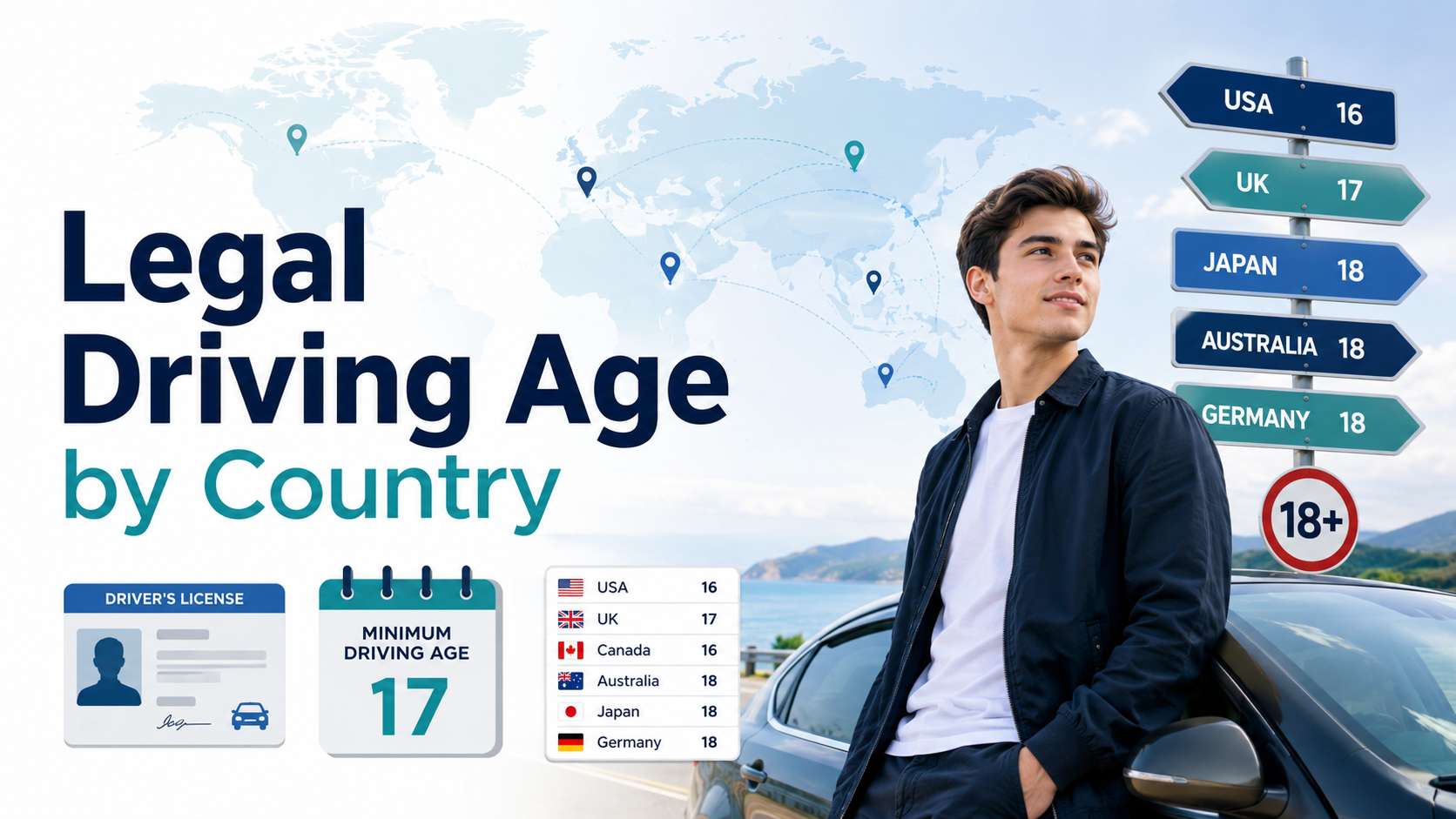
Unlike voting age, which is remarkably consistent worldwide, the legal driving age varies substantially, and it’s rarely a single number even within one country. Most places distinguish between a learner’s permit age, a supervised or provisional driving age, and a full unrestricted license age, and each of those can differ by state, province, or region.
Key Takeaways
- Most countries set the minimum age for a full, unrestricted driving license at 18, but many allow supervised or restricted driving well before that.
- The United States is unusual in allowing learner’s permits as early as 14 to 15 in some states, among the lowest in the world.
- The UK allows a provisional car license from 17, but mopeds from 16.
- Driving age is shaped by road safety data, public transportation availability, and cultural attitudes toward youth independence, not just tradition.
- Because driving laws are set at the state or provincial level in many countries, “the driving age” for a given country is often a range rather than a single number.
Why Driving Age Isn’t a Single Number
Ask “what’s the legal driving age” and the honest answer, for most countries, is “it depends on which stage of licensing you mean.” Most systems use a graduated licensing structure with distinct stages:
- Learner’s permit age: the earliest age at which someone can begin driving under supervision, often with a licensed adult in the vehicle.
- Provisional or restricted license age: an intermediate stage, sometimes with passenger limits, curfews, or other restrictions.
- Full unrestricted license age: the age at which all restrictions lift and the person can drive independently under normal conditions.
This is why “the driving age” for the same country can reasonably be reported as three different numbers depending on which stage is being discussed.
Minimum Driving Age by Country: A Comparison Table
| Country / Region | Learner’s Permit / Supervised Stage | Full / Unrestricted License |
|---|---|---|
| United States | As early as 14 to 15 in some states (varies significantly by state) | Typically 16 to 18, depending on the state |
| United Kingdom | Provisional car license from 17; moped from 16 with a CBT certificate | Full car license from 17, following a passed test |
| Canada | Graduated licensing, learner stage around 16 in most provinces | Full license typically available around 17 to 18 after graduated stages |
| Australia | Learner’s permit around 16, varies by state/territory | Full license typically 17 to 18, following graduated stages |
| Germany and most of Europe | Supervised driving from 17 in some countries | 18 |
| Brazil | No formal learner’s stage; direct testing process | 18 |
| Mexico | 15 with parental supervision in some regions | 16 to 18, depending on region and agreement |
| Japan, China, South Africa, Singapore | Generally no early learner stage | 18 |
| Ethiopia | Reported as low as 14 in some sources | Varies |
Note: driving age laws, especially in countries like the United States, Canada, and Australia where they’re set at the state or provincial level, vary significantly by specific location and can change. Always confirm the exact current rule with your local licensing authority (such as a DMV, DVLA, or equivalent) rather than relying on a single national figure.
How to Check If You Meet the Driving Age Requirement
| Step | What to Do | Why It Matters |
|---|---|---|
| 1 | Identify your country, and if applicable, your specific state or province | Driving age is frequently set at the regional level, not nationally |
| 2 | Determine which licensing stage you’re asking about (learner’s permit, provisional, or full license) | The relevant age can differ by several years depending on the stage |
| 3 | Calculate your exact age as of the date you plan to apply | Some licensing offices require you to have already reached the minimum age on the application date |
| 4 | Confirm any additional requirements (supervised hours, driving courses, parental consent) | Meeting the age requirement alone often isn’t sufficient |
Worked Examples
Example 1: Standard case, applying for a full license
- Country: United Kingdom (full license from 17, following a passed test)
- Date of birth: 12 April 2009
- Application date: 31 July 2026
- On the application date, this person is 17 years and about 3 months old.
- Result: eligible to hold a full car license, having already passed the minimum age threshold.
Example 2: Borderline case, learner’s permit just before eligibility
- Country: United States, hypothetical state with a permit age of 15
- Date of birth: 5 August 2011
- Application date: 31 July 2026
- On the application date, this person is still 14, turning 15 five days later.
- Result: not yet eligible, missing the permit age threshold by less than a week, illustrating how close borderline cases can be near a birthday.
Example 3: Different rules for different vehicle types in the same country
- Country: United Kingdom
- Age: 16
- At 16, this person can legally ride a moped with a CBT certificate, but cannot yet apply for a provisional car license, which requires being 17.
- Result: this person is legally allowed to operate one category of vehicle but not another, showing that “driving age” in a single country can mean different things depending on the vehicle type in question.
Manual Age Checking vs Using a Calculator
| Approach | Pros | Cons |
|---|---|---|
| Manual date comparison | Fine for a clear-cut case well past the threshold | Error-prone for borderline cases close to a birthday, and doesn’t automatically account for leap years |
| Using an age calculator | Gives an exact age instantly, including for future application dates, with no manual arithmetic errors | Still requires knowing the correct minimum age for your specific state, province, or country first |
Before applying for any license or permit, it’s worth confirming your exact age precisely. You can double-check your exact age first to avoid the kind of near-miss shown in Example 2 above.
Why Driving Age Varies So Much Between Countries
Three factors drive most of the variation seen in the comparison table above:
- Road safety statistics: countries with higher recorded rates of teen accidents often raise minimum ages or extend supervised learning periods as a direct policy response.
- Public transportation availability: in regions with strong public transit, teens have less practical need to drive early, which correlates with higher minimum driving ages; in car-dependent regions like much of the United States, ages tend to be lower.
- Cultural attitudes toward youth independence: some cultures encourage earlier independence and mobility for teenagers, while others favor extended parental oversight, and this shows up directly in licensing law.
Graduated Driver Licensing Explained
Many of the countries in the comparison table above use some version of a system called graduated driver licensing (GDL). Rather than granting full driving privileges the moment someone reaches a single minimum age, GDL phases privileges in over multiple stages, each with its own restrictions:
| Stage | Typical Restrictions | Purpose |
|---|---|---|
| Learner’s permit | Must drive with a licensed, often adult, supervisor at all times; no solo driving | Allows supervised practice before any independent driving |
| Provisional / intermediate license | May include passenger limits, nighttime driving curfews, or mobile phone restrictions | Reduces high-risk driving conditions during the highest-risk early period |
| Full / unrestricted license | All standard restrictions lifted | Reflects an assumed baseline level of experience and demonstrated competence |
Research consistently associates newly licensed teen drivers with substantially higher accident rates than more experienced drivers, which is the core justification for phasing privileges in gradually rather than granting them all at once. This is also why the “driving age” for a given country genuinely depends on which stage is being asked about, since a learner’s permit and a full license can be separated by two or more years even within the same jurisdiction.
Driving Age by US State: Why It Varies So Much
The United States is a particularly clear example of driving age varying by region rather than existing as one national figure. Since each state sets its own Department of Motor Vehicles (DMV) rules, the exact ages for a learner’s permit, intermediate license, and full license differ from state to state, sometimes by two years or more at each stage.
States with lower minimum ages tend to have larger rural areas with limited public transportation, where early driving privileges are treated as a practical necessity rather than a discretionary convenience. States with higher minimums, or stricter graduated licensing requirements, often cite road safety data specific to their own teen driver accident statistics as justification. Because of this state-by-state variation, anyone asking “what’s the driving age in the US” needs to specify a state to get an accurate, actionable answer rather than a single national figure.
Common Mistakes
| Mistake | Why It’s Wrong | The Fix |
|---|---|---|
| Assuming there’s one driving age per country | Most countries have separate ages for learner’s permits, provisional licenses, and full licenses | Specify which licensing stage you mean before comparing ages |
| Treating US, Canadian, or Australian driving age as a single national number | These countries set driving age at the state or provincial level, with real variation between regions | Check the specific state or province rather than assuming a national standard |
| Ignoring vehicle-type differences | Moped, motorcycle, and car licenses often have different minimum ages within the same country | Confirm the age requirement for the specific vehicle type in question |
| Calculating age as of today instead of the application date | Some licensing offices specifically require the applicant to have already reached the minimum age at application | Calculate age as of the actual application or test date |
| Assuming driving age laws don’t change | Some regions have adjusted minimum ages in response to road safety data | Confirm the current rule with the relevant licensing authority rather than relying on outdated information |
Frequently Asked Questions
What is the legal driving age in most countries? Eighteen is the most common age for a full, unrestricted driving license worldwide, though many countries allow supervised or restricted driving at a younger age.
What is the driving age in the United States? It varies by state. Some states allow learner’s permits as early as 14 to 15, with full unrestricted licenses typically available between 16 and 18, depending on the specific state’s graduated licensing rules.
What is the driving age in the UK? A provisional car license is available from age 17, following a passed test. Mopeds can be ridden from age 16 with a CBT certificate, so the applicable age depends on the vehicle type.
Is there a difference between a learner’s permit age and a full license age? Yes, and it’s often a significant gap. A learner’s permit allows supervised driving at a younger age, while a full, unrestricted license typically requires being older and passing further requirements.
Why do driving ages vary so much between countries? Largely due to differences in road safety statistics, the availability of public transportation, and cultural attitudes toward youth independence, all of which influence how governments set minimum driving ages.
Does the legal driving age differ for motorcycles or mopeds compared to cars? Often, yes. Many countries, including the UK, allow mopeds or motorcycles at a younger age than cars, so it’s worth checking the specific vehicle category.
How can I check my exact age before applying for a permit or license? You can double-check your exact age as of your planned application date, which is especially useful if your birthday falls close to the relevant deadline.
Is driving age set nationally or regionally? It depends on the country. In the United States, Canada, and Australia, driving age is largely set at the state or provincial level, meaning there’s real variation within the same country. In many other countries, it’s set nationally.
Double-Check Your Age Before You Apply
Since driving age eligibility often comes down to being on the right side of a specific birthday, especially for learner’s permits and provisional licenses, it’s worth confirming your exact age before applying. You can double-check your exact age first and avoid the kind of near-miss shown in the worked examples above.
Driving age is a similar age requirement to voting age in that both vary meaningfully by country, so if you’re researching one, it’s worth checking the other too, particularly if you’re planning around an upcoming birthday and multiple milestones at once.