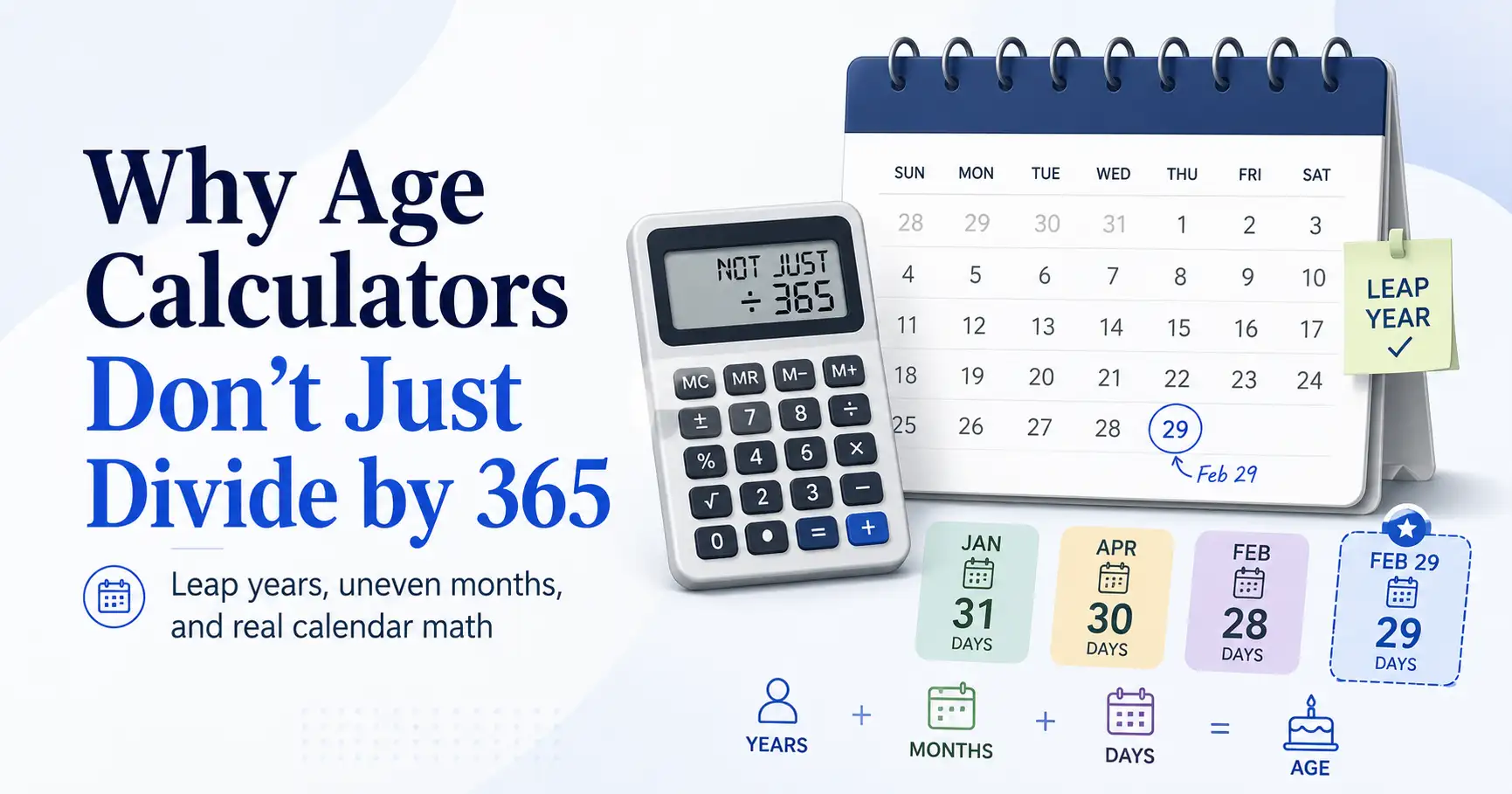
Type your birth date into an age calculator and it spits out an answer in seconds: years, months, and days, down to the exact figure. It feels like simple math. Subtract your birth date from today’s date, divide by 365, done. But if you’ve ever tried that shortcut on paper and compared it to what an online tool gives you, the numbers don’t quite line up. The gap isn’t a bug. It’s because a year isn’t actually 365 days, and neither is a month a fixed number of days, and the whole system of counting age is built on a calendar that’s messier than it looks.
Here’s why real age calculation takes a lot more than one division problem, and how a tool like this one can actually calculate your exact age here.
A concrete example. Take someone born on March 1, 2000. As of July 30, 2026, they have lived exactly 9,647 days.
| Method | Result |
|---|---|
| Naive: total days ÷ 365 | 26 years and 157 days |
| Accurate: calendar-based calculation | 26 years, 4 months, and 29 days (151 days into year 27) |
| Drift | 6 days |
That six-day gap comes entirely from the leap years tucked inside those 26 years, and it only grows the longer someone has been alive.
The 365-Day Assumption Breaks Almost Immediately
A calendar year is 365.2422 days long, not an even 365. That extra roughly quarter-day is why we have leap years, an adjustment squeezed in every four years (with a few exceptions) to keep the calendar in sync with Earth’s orbit. If an age calculator simply divided total days lived by 365, it would drift further from your real age with every leap year that’s passed since you were born. Live to 80, and that naive division could be off by nearly three weeks.
This is the first reason age math is harder than it looks: the length of a “year” isn’t constant in the way a division formula assumes.
Months Aren’t Equal Either
The complications don’t stop at years. Months range from 28 to 31 days, and February itself changes length depending on the year. If someone was born on January 31st, what does “one month later” even mean in a 30-day month like April? There’s no single mathematically clean answer. It requires a rule (usually “the last valid day of the month”) rather than a formula you can divide your way into.
A proper age calculator has to work in calendar units, meaning years, months, and days as humans actually experience them, rather than converting everything into a single number of days and dividing. That’s part of why doing the same math by hand is more involved than most people expect, even for something that feels like basic subtraction.
Leap Years Complicate Things Further
Because leap years insert an extra day roughly every four years, the exact number of days between two dates depends on which years fall in between, not just how many years have passed. Someone born in a leap year, or whose birthday range spans a different number of leap years than someone born a day earlier, will have a slightly different total day count for what looks like the “same” age gap.
This is especially true when leap years complicate this further for people trying to calculate exact ages that span decades. The cumulative effect of all those extra days adds up, and a calculator needs to account for every leap year individually rather than assuming a flat average.
The longer someone has been alive, the more leap days accumulate, and the further a naive 365-day division drifts from the truth:
| Years Lived | Approx. Leap Days Accumulated | Drift If You Divide by 365 |
|---|---|---|
| 10 | 3 | ~3 days |
| 20 | 5 | ~5 days |
| 40 | 10 | ~10 days |
| 80 | 20 | ~20 days (nearly 3 weeks) |
Leap day counts follow the Gregorian calendar rule: a year is a leap year if divisible by 4, except century years, which must be divisible by 400 (so 2000 was a leap year, but 1900 and 2100 are not). Figures above are approximate and assume the span includes a typical, non-century-heavy stretch of years.
The Edge Case Everyone Forgets: February 29th
And then there’s the trickiest wrinkle of all: what happens if you were actually born on February 29th? Your official birthday only exists on the calendar once every four years. Most systems, including legal ones, have to make a judgment call about whether your birthday falls on February 28th or March 1st in non-leap years. It’s a small population affected, but it’s a perfect example of how age calculation isn’t just arithmetic. It’s arithmetic plus a set of calendar rules and conventions. If you want to see exactly how this is handled, leap-day birthdays get their own dedicated breakdown.
So What Does a Real Age Calculation Actually Do?
Instead of dividing total days by 365, an accurate age calculator works through calendar logic in order:
| Step | What It Does | Why It Matters |
|---|---|---|
| 1. Count whole years | Counts full years between the birth date and today, based on calendar year boundaries | Establishes the baseline age without relying on an averaged year length |
| 2. Count whole months | Counts remaining full months after the year count, adjusting for the actual number of days in each month | Prevents errors from months of different lengths (28 to 31 days) |
| 3. Count remaining days | Counts the leftover days, accounting for every leap year that falls within the span | Captures the exact leap-day adjustments a flat 365-day divisor would miss |
| 4. Apply edge-case rules | Handles cases like February 29th birthdays or month-end dates that don’t exist in every month | Ensures rare but real dates still produce a defensible, consistent answer |
This is essentially the same process someone would follow doing it manually with a calendar. The calculator is just doing it instantly, precisely, and without the risk of miscounting a leap year or a short month along the way.
Why This Matters Beyond Curiosity
Getting age exactly right isn’t just a fun exercise. Exact ages matter for things like school enrollment cutoffs, legal eligibility milestones, medical dosing calculations, and countless administrative processes where “approximately” isn’t good enough. A calculator that’s quietly off by a few days because it divided by 365 instead of accounting for real calendar mechanics could give someone the wrong answer at a moment when precision actually counts.
The Bottom Line
Age calculation looks like simple math from the outside, but it’s really a small calendar-logic problem: uneven month lengths, periodic leap-year corrections, and edge cases like February 29th all have to be handled correctly, not approximated. That’s the difference between a rough guess and a tool you can actually trust with an exact answer. Calculate your exact age here and see precisely how many years, months, and days you’ve been alive.
3 thoughts on “Why Age Calculators Don’t Just Divide by 365”