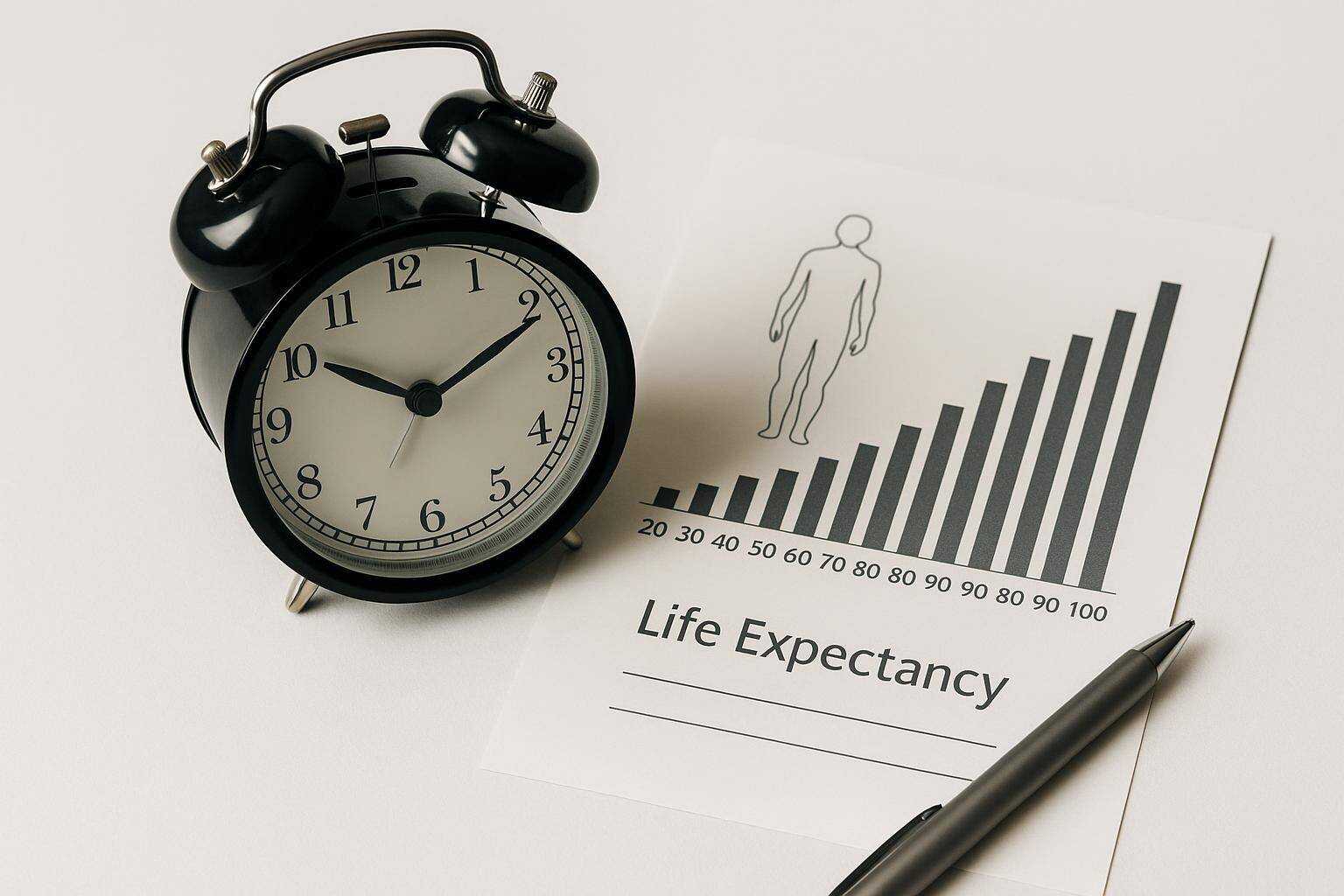
“Death clock” calculators promise something no legitimate statistical model can actually deliver: a specific date. Type in your birthday, answer a short quiz about your habits, and the tool spits back a projected date of death down to the day. It’s dramatic, shareable, and almost entirely for entertainment. This guide explains exactly how these tools generate that number, why the specificity is misleading, and how a death calculator by date of birth compares to the more grounded actuarial models used by insurers and pension funds.
Key Takeaways
- Death clock calculators use the same underlying actuarial data as legitimate life expectancy tools, but they present the output with false precision, a specific date instead of a probability range.
- No calculator, however sophisticated, can predict an individual’s actual date of death. Mortality is probabilistic at the population level and effectively unpredictable at the individual level.
- The starting input for every version of these tools is your exact age, calculated from your date of birth. You can check your exact age instead using a free, precise age calculator.
- Lifestyle quiz questions (smoking, diet, exercise, stress) are usually mapped to published relative-risk studies, but the way each site weights them varies enormously, which is why different death clocks give wildly different answers for the same person.
- These tools are best treated as an engaging way to think about mortality risk factors, not as a forecast to plan around.
How a Death Clock Calculator Actually Works
Behind the dramatic countdown, most death clock tools follow a fairly standard process:
| Step | What the Tool Does | Where the Data Comes From |
|---|---|---|
| 1. Calculate your exact current age | Converts your date of birth into a precise age | Your input |
| 2. Pull a baseline life expectancy | Matches you to an average lifespan figure for your age, sex, and often country | National mortality tables |
| 3. Apply lifestyle modifiers | Adjusts the baseline up or down based on quiz answers (smoking, exercise, alcohol, sleep, etc.) | Published epidemiological studies, weighted differently by each tool |
| 4. Add randomization or “personality” | Some tools add a small randomized variance to make each result feel unique | Proprietary, undisclosed |
| 5. Convert to a specific date | The final adjusted life expectancy number is translated into a calendar date | Simple date arithmetic from your birth date |
Step 4 and step 5 are where these tools depart furthest from anything statistically defensible. Step 3 is grounded in real research; step 5 dresses that research up as a fortune-telling exercise.
Why the Specific Date Is Statistically Meaningless
A life expectancy estimate is really the peak of a wide probability curve, not a fixed point. If a calculator says your life expectancy is 81 years, that doesn’t mean everyone like you dies at 81. It means the average across a large population lands there, while individuals in that same population die anywhere from their 40s to past 100.
Turning “81 years average” into “you will die on March 12, 2071” takes a statistic that’s only meaningful in aggregate and dresses it up as an individual forecast. It’s the equivalent of predicting the exact temperature in a city ten years from today based on the region’s average climate, technically derived from real data, but far outside what that data can actually support at the individual level.
Two Worked Examples
Example 1: Two people, same birth date, different calculators
Two people are both born on June 4, 1985. Person A uses a death clock calculator that weights smoking status heavily; Person B, a non-smoker with an active lifestyle, uses the same tool. Person A (a smoker) might get a projected date roughly 9 years earlier than Person B, even though both are the same exact age down to the day. That’s a legitimate reflection of published smoking-mortality risk data. Where it gets less legitimate is if a third person plugs the exact same details into a different death clock site and gets a projected date that differs by 15 years from either of the first two results, purely because that tool weights the same lifestyle inputs differently.
Example 2: The “instant refresh” problem
Some novelty death clocks let you refresh the page and get a slightly different date each time, due to a built-in random variance meant to make the experience feel more “alive.” This is a useful tell: if reloading the same inputs changes the output, the number was never meant to be a serious estimate in the first place. A genuine actuarial calculation with the same inputs should return the same result every time.
Example 3: Edge case, quiz-heavy calculators vs. simple calculators
Some death clock tools ask ten or more lifestyle questions (diet, stress levels, sleep quality, family history, alcohol consumption), while others ask only for date of birth and sex. A person answering the detailed quiz version might get a projected date that shifts by several years compared to the same person using a bare-bones version of the tool, purely because the detailed version is applying more adjustment layers on top of the same base life table. Neither version is more “correct” in an absolute sense, since both are working from unverified self-reported inputs. The detailed version simply produces a more heavily adjusted number, not necessarily a more accurate one, unless the underlying weighting has been validated against real outcome data.
Why These Tools Remain So Popular
Despite the statistical shakiness of a specific projected date, death clock calculators have stayed popular online for years. Part of the appeal is psychological: a specific date feels more concrete and shareable than an abstract range of years, even though the range is the more honest answer. Part of it is simply entertainment value, similar to a horoscope or personality quiz, where the appeal is the experience of engaging with the question rather than a genuine expectation of predictive accuracy.
There’s also a legitimate underlying curiosity these tools tap into: most people have never seen how mortality statistics work, and a death clock calculator, however dramatized, is often someone’s first exposure to the idea that life expectancy is calculated from age- and sex-based population data in the first place. Used with the right framing, that curiosity can be a reasonable entry point into learning about actuarial life tables, even if the specific date output should be taken with a large grain of salt.
Death Clock vs. Legitimate Life Expectancy Calculator
| Feature | Death Clock (novelty) | Actuarial Life Expectancy Calculator |
|---|---|---|
| Output format | Specific calendar date | Average number of remaining years, sometimes a range |
| Data transparency | Rarely discloses sources or weighting | Usually cites a named life table (CDC, ONS, WHO, etc.) |
| Consistency | May vary between refreshes or platforms | Consistent for the same inputs |
| Intended use | Entertainment | Financial and retirement planning, general health awareness |
| Statistical validity | Low, for the specific date claim | Reasonable, for the average estimate |
If you want an estimate closer to what an actuary or pension fund would actually use, How Long Will I Live? Understanding Life Expectancy Calculators walks through how these estimates are actually built, using the same underlying life table method without the theatrical date-of-death framing.
Common Mistakes People Make With These Tools
| Mistake | Why It’s Wrong | The Fix |
|---|---|---|
| Treating the exact date as meaningful | The date is a dramatic presentation layer over an average estimate, not a real forecast | Read the underlying life expectancy range instead, if the tool provides one |
| Comparing results across different sites | Each tool weights lifestyle factors differently, with no shared standard | Stick to one tool if you want to track changes over time, and don’t compare absolute numbers across sites |
| Letting the result affect financial or health decisions directly | These outputs aren’t built to the standard of actuarial or medical-grade tools | Use insurer-grade or clinically validated calculators for anything with real financial or health stakes |
| Assuming a longer projected date means a guaranteed healthy life | Life expectancy averages don’t account for quality of life or specific health conditions | Treat the number as one input among many, alongside actual medical guidance |
| Not knowing your own exact age before starting | Some tools miscalculate if the date of birth field is entered incorrectly (day/month swapped, for example) | Double-check your exact age separately with a reliable age calculator before running any lifespan estimate |
What These Tools Get Right
It’s worth being fair to these calculators: the underlying inputs, age, sex, smoking status, activity level, are all legitimate, well-studied mortality risk factors. Large-scale cohort studies genuinely do show that smokers have shorter average lifespans than non-smokers, that regular physical activity correlates with longer average lifespans, and that certain chronic conditions shift risk in measurable ways. A death clock calculator isn’t lying about the direction of these effects, it’s usually only exaggerating the precision of the final output.
A death clock estimate, however dramatic, is just one lens on the broader question of aging and mortality risk. If you’re more interested in a related, less theatrical milestone, What Age Is Considered a Senior Citizen? covers a related milestone worth knowing that ties directly into the same life-stage thinking these calculators are built around.
A Practical Way to Use These Tools Without Being Misled
If you enjoy death clock calculators and want to keep using them, a few habits keep the experience fun without drifting into treating the output as a real forecast. Focus on the direction of the lifestyle adjustments rather than the specific date, since a calculator showing your projected date moving later after you improve a habit like sleep or exercise is a reasonably honest reflection of published research, even if the exact date itself isn’t. Avoid comparing your result against a friend’s result from a different website, since the underlying models rarely match. And if a specific result ever causes real anxiety, it’s worth remembering that the tool is working from population averages and rough lifestyle weighting, not any information specific to your actual health, and stepping away from the calculator entirely is a perfectly reasonable response.
Methodology Note
The mortality risk factors referenced in death clock and life expectancy calculators generally trace back to long-running epidemiological cohort studies (such as national health surveys and insurance mortality studies) and standard actuarial life tables published by government statistics agencies. The specific-date output format, however, is a presentation choice made by individual calculator developers and isn’t part of any standardized actuarial methodology.
Frequently Asked Questions
Can any calculator actually predict my exact date of death?
No. Mortality is inherently unpredictable at the individual level. Even the most sophisticated actuarial models only produce probability distributions and averages, never a specific date for one person.
Why do different death clock websites give me different dates?
Each tool uses its own combination of life tables, lifestyle weighting, and sometimes randomization. There’s no industry standard for how these calculators are built, so variation between sites is expected.
Are the lifestyle questions in these calculators based on real research?
Generally yes, factors like smoking, exercise, alcohol use, and sleep are backed by real epidemiological studies showing correlations with average lifespan. How heavily each factor is weighted in a given calculator, though, is usually not disclosed.
Is it healthy to use these calculators regularly?
For most people, using one occasionally out of curiosity is harmless. If checking a death clock repeatedly is causing anxiety or distress about mortality, it’s worth stepping back from the tool and, if the worry persists, talking to a professional.
How is my starting age calculated in these tools?
The same way as any age calculator, by measuring the exact number of days between your date of birth and today, then converting that into years, months, and days. You can verify your own exact age with a dedicated age calculator before trying a lifespan tool.
Do these calculators account for family medical history?
Most basic versions don’t, since family history isn’t a standardized input the way age and sex are. A small number of more detailed health calculators include an optional family history question.
What’s the difference between a death clock and an insurance company’s life expectancy estimate?
Insurance companies use fully disclosed, regulated actuarial tables and often incorporate medical underwriting (blood tests, health questionnaires). Death clocks are consumer novelty tools with undisclosed or loosely applied methodology, aimed at entertainment rather than underwriting accuracy.
Should I use a death clock result for retirement or insurance planning?
No, or just check your exact age instead and use a properly sourced actuarial life expectancy calculator for that kind of planning. Death clocks are built for engagement, not for the kind of precision that financial planning requires.