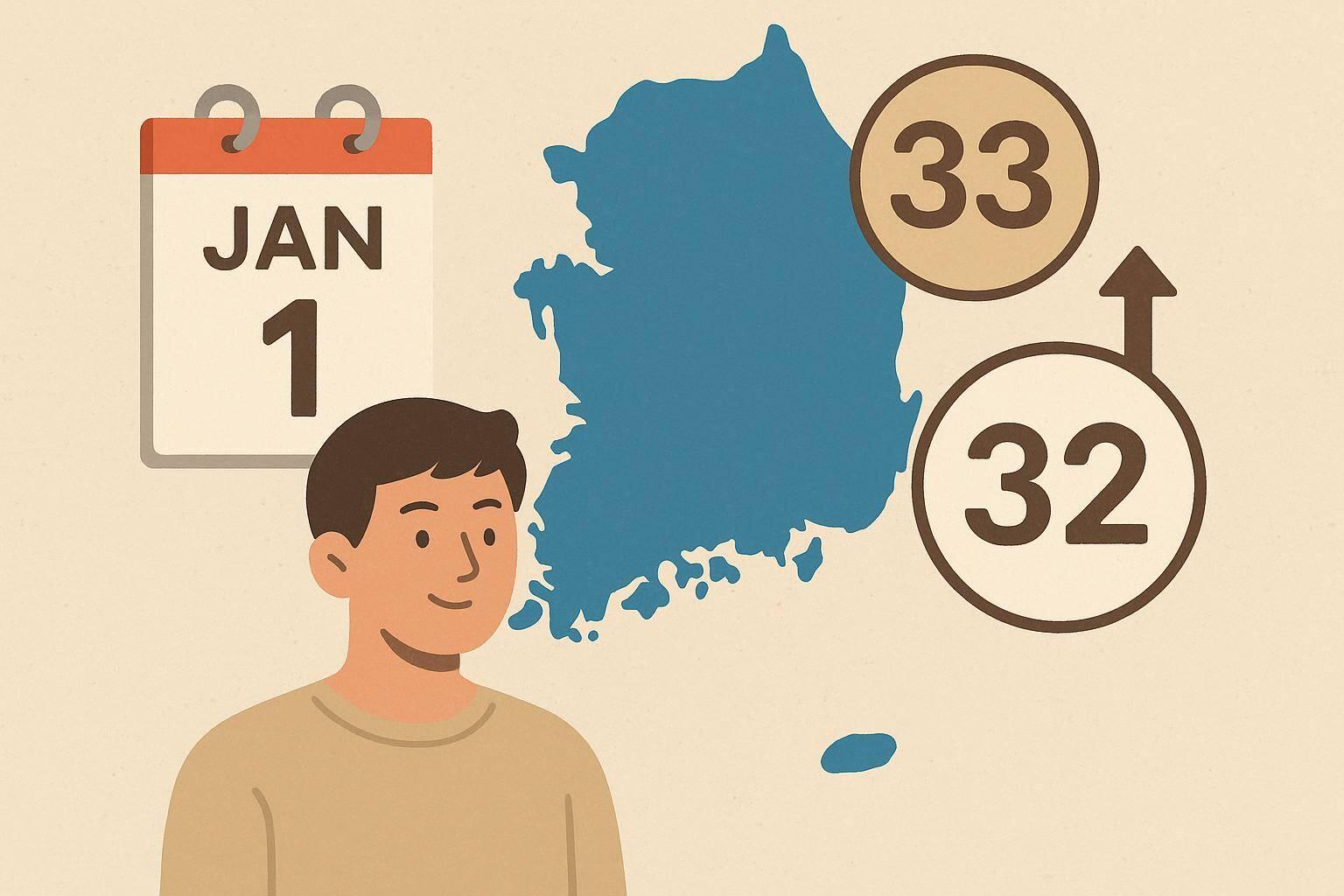
If you’ve ever heard someone say they’re “two years older in Korean age” than their passport suggests, you’ve run into one of the more distinctive age-counting systems still used today. Traditional Korean age doesn’t count from your exact birth date the way most of the world does, it counts differently enough that a recent law had to formally standardize which system counts for official purposes. This guide explains how the traditional system works, how it compares to international age, and what changed in 2023.
Key Takeaways
- Traditional Korean age counts a person as 1 year old at birth, not 0, and everyone gains a year on New Year’s Day (January 1st) rather than on their individual birthday.
- This means someone born in December could be considered “2 years old” in Korean age just one month after birth, since they turn 1 at birth and gain another year at the next January 1st.
- In June 2023, South Korea passed a law standardizing the use of international age (the age system used in most of the world, counted from birth date, starting at 0) for most legal and administrative purposes.
- Traditional Korean age (and a related “counting age” system) is still used informally and culturally, even though international age is now the legal standard.
- International age is calculated the same way our free age calculator works: starting at 0 at birth and increasing by one on each birthday.
How Traditional Korean Age Actually Works
Traditional Korean age (often called “counting age” or Se-nai) follows two rules that differ from international age counting:
| Rule | Traditional Korean Age | International Age (Western standard) |
|---|---|---|
| Starting age at birth | 1 year old | 0 years old |
| When age increases | Everyone gains a year on January 1st (New Year’s Day), regardless of individual birth date | Each individual gains a year on their own specific birthday |
| Result | Korean age is typically 1 to 2 years higher than international age, depending on the time of year | Matches the exact chronological age calculated from date of birth |
The reasoning behind counting age 1 at birth traces back to a traditional East Asian view that time in the womb counts as a person’s first year of life. The January 1st increase, rather than an individual birthday, reflects an older cultural emphasis on the calendar year as a shared marker of age for an entire community, rather than each person’s specific birth date.
Two Worked Examples
Example 1: Someone born early in the year
Someone is born on March 10, 1995. Under traditional Korean age counting, they are 1 year old at birth. When January 1, 1996 arrives, less than a year later, they become 2 years old in Korean age, even though they haven’t yet had their first actual birthday. By the time their actual first birthday (March 10, 1996) arrives, they’re already counted as 2 in the Korean system, while international age counting would have them turning 1 on that same date.
Example 2: Edge case, someone born in December
Someone is born on December 20, 1995. Under traditional Korean age counting, they’re 1 year old at birth, on December 20. Just 12 days later, on January 1, 1996, they become 2 years old in Korean age, despite being less than two weeks old in actual elapsed time. Meanwhile, their international age at that point is still 0, since they haven’t reached their first birthday. This is the clearest illustration of how dramatically the two systems can diverge, a difference of nearly two full years in Korean age counting for a baby who is, in international terms, less than a month old.
Example 3: Edge case, comparing generations at a family gathering
At a Korean family gathering, a grandmother born in early January might state her traditional Korean age as one full year higher than her actual international age, since her birthday falls early enough in the year that the January 1st increase and her actual birthday are close together, minimizing the usual confusion. Meanwhile, her grandson, born in late November, has a Korean age that’s nearly two full years ahead of his international age for most of the year, since he gains a Korean age year on January 1st despite having barely completed a fraction of that year in international terms. If both state their “age” at the same family gathering using the traditional system, the apparent gap between grandmother and grandson in Korean age can actually differ from the true gap in international age, depending on each person’s specific birth month. This is a genuinely confusing real-world scenario that partly motivated the push toward the 2023 standardization.
Cultural Persistence Alongside Legal Standardization
Even after the 2023 law, traditional Korean age hasn’t disappeared from daily life. It’s common for Koreans to ask “what’s your Korean age” specifically in casual conversation, and many people still mentally track both numbers. Cultural practices tied to age, honorifics in the Korean language that shift based on relative age between speakers, for example, still often reference the traditional system informally, even though official paperwork now uses international age.
This split between legal standard and cultural habit isn’t unique to Korea. Many countries have official conventions that differ from everyday informal practice around age, birthdays, or other date-based customs. What makes the Korean case particularly notable is simply how large the numerical gap between the two systems can be, up to two full years, compared to most other regional variations in age-counting customs around the world.
Traditional Korean Age vs. International Age vs. “Counting Age”
South Korea has historically used up to three different age systems depending on context, which is part of why the 2023 law was introduced in the first place:
| System | How Age Is Counted | Where It Was Used |
|---|---|---|
| International age | 0 at birth, increases on individual birthday | Now the legal standard for most contexts since the 2023 law |
| Traditional Korean age (Se-nai) | 1 at birth, increases for everyone on January 1st | Still used culturally and in everyday conversation |
| “Counting age” for specific laws | Age counted from the calendar year of birth, similar to but not identical to traditional Korean age, was previously used for specific legal contexts like drinking age and military conscription | Mostly phased out by the 2023 standardization, though a few specific laws still use year-based counting |
What Changed With the 2023 Law
In June 2023, South Korea’s National Assembly passed legislation formally standardizing international age as the default for government documents, contracts, medical records, and most legal purposes. Before this law, having up to three different age systems in simultaneous use caused genuine confusion, for example, in insurance claims, medical dosing calculations, and eligibility rules where it wasn’t always clear which “age” applied.
The law didn’t ban traditional Korean age from cultural or everyday use, Koreans still commonly ask and state their age in the traditional counting system in casual conversation, but it did remove the traditional system from official government and legal contexts, replacing it with the same birth-date-based counting used in most of the rest of the world.
A small number of specific laws, such as those governing the legal drinking and smoking age, continued to use year-of-birth-based counting even after the reform, so it’s worth checking the specific context if precision matters for a legal purpose in Korea.
Common Mistakes When Comparing Age Systems
| Mistake | Why It’s Wrong | The Fix |
|---|---|---|
| Assuming Korean age is always exactly 1 year higher than international age | The gap can be 1 or 2 years depending on whether the person’s birthday has occurred yet this calendar year | Check both the birth date and the current date, not just a flat “+1” assumption |
| Applying traditional Korean age to legal or official South Korean documents post-2023 | Since June 2023, international age is the legal standard for most official purposes in South Korea | Use international age for anything legal, medical, or administrative in a South Korean context |
| Assuming all East Asian countries use the same age system | Traditional age-counting practices vary by country and have been phased out or modified at different times across the region | Confirm the specific country’s current legal standard rather than generalizing from one country to another |
| Confusing “counting age” with “traditional Korean age” | These are related but not always identical, since counting age was historically used for a narrower set of specific legal rules | Treat them as related but separate systems when precision matters |
| Calculating international age incorrectly by using year-only subtraction | International age still needs to account for whether the individual birthday has passed this year, the same requirement covered in any accurate age calculation | Use a proper date-of-birth-based calculation, the same method used to calculate your age from your date of birth |
How This Connects to the Broader Calendar System
Age-counting conventions like traditional Korean age are, at their core, a different cultural rule layered on top of the same underlying calendar. Understanding the Gregorian Calendar and How Dates Work covers how the Gregorian calendar underpins Western age counting, which is useful context for understanding that the calendar itself isn’t what differs between these systems, it’s the specific counting rule applied to it.
Leap years add another small wrinkle to any age-counting system, including Korean age. What Is a Leap Year and Why Do We Have Them? covers another quirk of calendar-based age systems that applies regardless of which counting convention is being used.
Why This Matters Beyond Korea
Understanding traditional Korean age isn’t just useful for travelers or people with Korean family connections, it’s a genuinely useful case study in how age itself is a cultural convention layered on top of objective calendar math, not a single universal concept. Anyone doing business with Korean partners, studying in Korea, or navigating Korean medical or legal paperwork benefits from knowing which system applies in which context, since assuming the wrong one could lead to real confusion, particularly around anything with an age-based eligibility requirement. More broadly, the Korean case is a useful reminder that whenever comparing ages across cultures or historical records, the underlying counting convention is always worth double-checking rather than assumed.
Methodology Note
This guide describes the traditional Korean age system as commonly documented in South Korean government communications and news coverage of the 2023 age standardization law, alongside the international (ISO-standard) age counting method used by most countries and reflected in standard chronological age calculators.
Frequently Asked Questions
Is traditional Korean age still legally used in South Korea?
No, not since June 2023. International age is now the legal standard for most government, medical, and legal purposes in South Korea, though traditional Korean age is still used informally in everyday conversation.
Why does traditional Korean age start at 1 instead of 0?
It reflects a traditional view that time spent in the womb counts as the first year of life, so a newborn is considered to already be 1 year old at birth under this system.
Why does Korean age increase on January 1st instead of on an individual’s birthday?
Traditional Korean age counting treats the calendar year, not an individual’s specific birth date, as the shared marker for aging, so everyone’s age increases together at the start of each new year.
How much older is someone in Korean age compared to international age?
It depends on the time of year. The difference is typically 1 year, but can be as much as 2 years for someone born late in the calendar year, since they gain a Korean age year almost immediately at the following New Year.
Do other countries use a similar age-counting system?
Yes, some other East Asian countries have historically used similar birth-year-based counting conventions, though many, including South Korea as of 2023, have since standardized on international age for official purposes.
How do I calculate someone’s international age from their date of birth?
The same way most standard age calculators work: count the exact years, months, and days between the birth date and today, increasing the age count only when the individual’s specific birthday has occurred. You can see how your age compares using our calculator to check this instantly.
Are there still any exceptions where Korean age or counting age is used legally?
A small number of specific laws, such as certain age-restriction rules around alcohol and tobacco, continued to use year-of-birth-based counting even after the 2023 reform, so it’s worth checking the specific legal context rather than assuming international age applies universally.
Does the Korean age system affect how birthdays are celebrated?
Not directly, individual birthdays are still celebrated on the actual birth date in South Korea. The age-counting difference mainly affects how old someone says they are, rather than when their birthday celebration occurs.