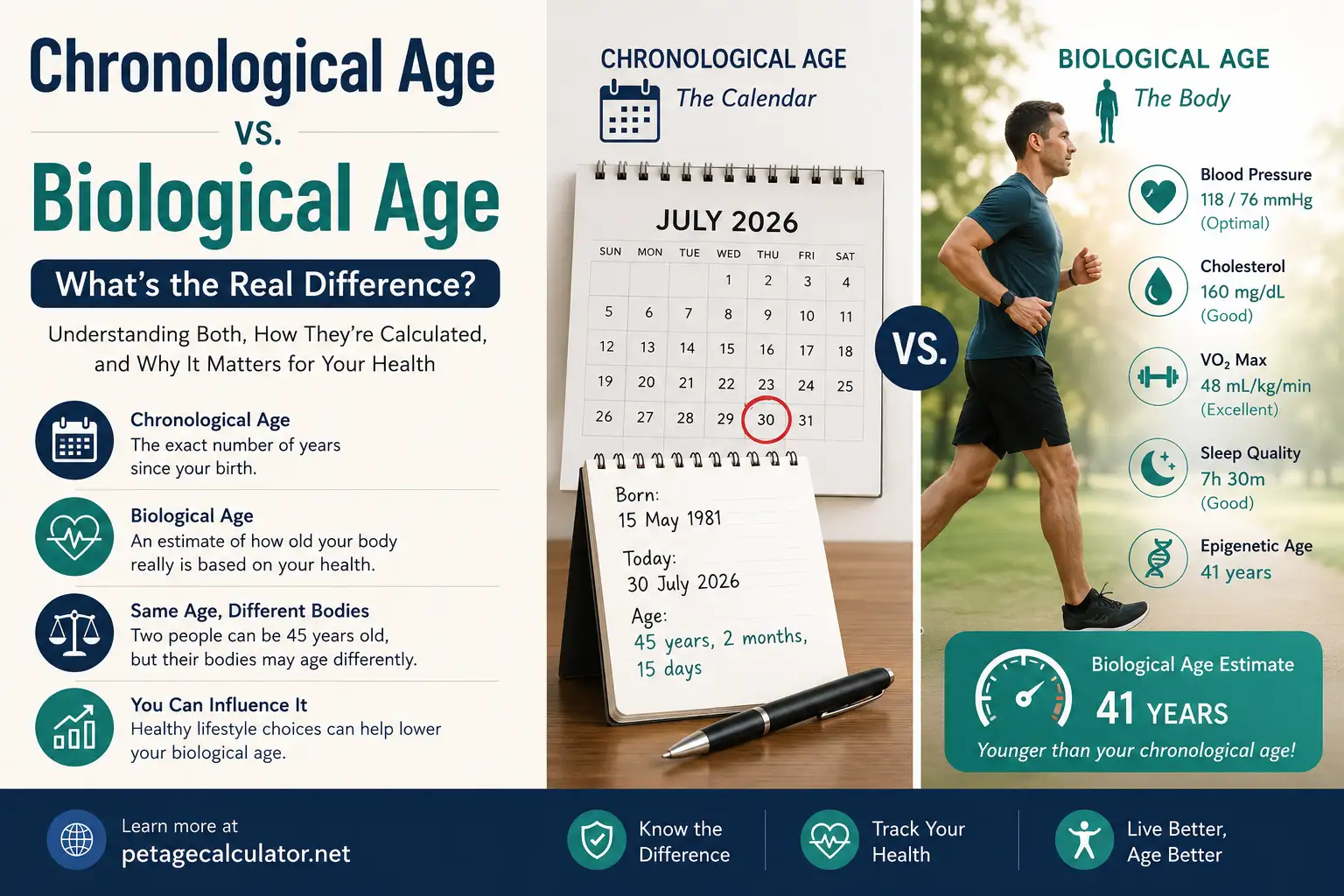
You have a number on your ID that says how old you are. That number never lies, and it never changes speed. But it also does not tell you how your heart, lungs, or cells are actually holding up. That is the gap between chronological age and biological age, and it is a bigger gap than most people realize.
Key Takeaways
- Chronological age is simply the time elapsed since your date of birth. It is fixed, exact, and identical for everyone born on the same day.
- Biological age is an estimate of how “old” your body’s cells, organs, and systems appear to be, based on measurable markers rather than the calendar.
- Two people with the same chronological age can have biological ages that differ by 10 years or more, depending on genetics, lifestyle, and health history.
- Biological age is estimated, not exact. Different tests (epigenetic clocks, blood biomarker panels, fitness-based calculators) can give different results for the same person.
- Chronological age is what you need for legal, administrative, and eligibility purposes. Biological age is a wellness signal, not an official measurement.
What Is Chronological Age?
Chronological age is the plain, calendar-based measurement of time between your date of birth and today. If you were born on June 10, 2000, your chronological age on June 10, 2026 is exactly 26 years, no more and no less. It accounts for leap years automatically once you calculate it correctly, which is how chronological age is actually calculated behind the scenes.
This is the number used on passports, birth certificates, school enrollment forms, driver’s licenses, and every legal document that requires an age. It is objective, verifiable, and identical for every person sharing that exact birth date.
What Is Biological Age?
Biological age (sometimes called “physiological age” or “true age”) is an estimate of how old your body seems based on measurable indicators of aging rather than the date on your birth certificate. Researchers and wellness companies calculate it using a combination of factors that tend to change as cells and tissues age, such as:
- DNA methylation patterns (used in “epigenetic clocks” like the Horvath clock)
- Blood biomarkers such as cholesterol, blood sugar, inflammation markers, and kidney function
- Grip strength, VO2 max, and other physical fitness measures
- Telomere length (the protective caps on the ends of chromosomes)
- Skin elasticity and other visible aging markers, in less rigorous consumer tests
The output is a single number meant to represent “biological age,” which can be higher or lower than chronological age depending on how well or poorly the body has aged relative to average.
How the Two Are Calculated: A Side-by-Side Look
| Step | Chronological Age | Biological Age |
|---|---|---|
| Input data | Date of birth and current date | Blood tests, DNA samples, fitness metrics, or lifestyle questionnaires |
| Method | Subtract birth date from today’s date, adjusting for leap years and month lengths | Statistical model comparing your biomarkers to population averages at each age |
| Tools used | Age calculators, calendars, manual date subtraction | Lab panels, epigenetic clock tests, fitness-tracker algorithms, biological age calculators |
| Result type | Exact, single correct answer | Estimate that varies by method and can shift over time |
| Changes over time | Increases by exactly one year, every year | Can increase, decrease, or stay flat depending on health changes |
Worked Examples
Example 1: The Standard Case
Maria was born on March 15, 1990. As of March 15, 2026, her chronological age is exactly 36 years. A blood panel and fitness assessment estimate her biological age at 33 years, meaning her body’s measurable health markers resemble those of a typical 33-year-old rather than a 36-year-old. This is a common, unremarkable result for someone with consistent exercise and normal bloodwork.
Example 2: A Large Gap
James is 45 years old chronologically. Years of smoking, high blood pressure, and disrupted sleep patterns push his estimated biological age to 54 on an epigenetic clock test, a 9-year gap in the “older” direction. His chronological age will keep climbing at the same fixed rate regardless, but his biological age is a signal that his lifestyle is accelerating cellular aging faster than average.
Example 3: The Edge Case of Twins
Identical twins Anna and Rosa share the exact same chronological age down to the minute, since they were born on the same day. Twenty years later, Anna has worked a physically demanding outdoor job with high sun exposure and irregular sleep, while Rosa has worked a desk job with a stable routine. Despite identical chronological ages, their biological age tests show a 4 to 6 year difference, driven almost entirely by environment and lifestyle rather than genetics, since their DNA is nearly identical. This illustrates that chronological age is genetic-neutral and time-fixed, while biological age is responsive to everything that happens after birth.
Why the Difference Actually Matters
Chronological age is unavoidable and non-negotiable. It determines when you can vote, drive, retire, or enroll a child in school, and no amount of clean living changes the number itself. Biological age matters for a different reason entirely: it is a rough proxy for health risk and life expectancy. Research using epigenetic clocks has repeatedly found that a higher biological age relative to chronological age correlates with increased risk of age-related disease and mortality, independent of chronological age alone.
This is why biological age has become a popular wellness metric. It reframes health goals away from “how many years do I have” toward “how well is my body actually functioning right now,” which is something people can influence through sleep, diet, exercise, and stress management.
Common Mistakes People Make
| Mistake | Why It’s Wrong | The Fix |
|---|---|---|
| Treating biological age as a precise, official number | It is a statistical estimate built on a model, not a direct measurement like chronological age | Treat the result as a directional signal (trending better or worse), not a certified figure |
| Assuming one biological age test is definitive | Epigenetic clocks, blood panels, and fitness-based calculators can each produce a different number for the same person | Compare results from the same test over time rather than comparing across different test types |
| Using biological age for legal or administrative purposes | Only chronological age is recognized for legal identity, eligibility, and documentation | Use a standard age calculator for anything requiring an official age |
| Ignoring measurement error in age calculation itself | Manually subtracting birth year from current year without adjusting for month and day produces an incorrect chronological age | Use a proper date-based calculation or a reliable age calculator |
| Assuming biological age can only go up | Studies on epigenetic clocks have shown biological age can decrease with sustained lifestyle changes | Track it periodically rather than assuming decline is inevitable |
A Note on Methodology
This guide follows standard chronological age arithmetic based on the Gregorian calendar, including proper handling of leap years, which is explained in full in our companion piece on how chronological age is actually calculated. Biological age figures cited here reflect the general findings of peer-reviewed epigenetic clock research (such as the Horvath and PhenoAge models), which is a distinct field from calendar-based age calculation and should not be confused with it.
Frequently Asked Questions
Is biological age more accurate than chronological age?
They measure different things, so “more accurate” is not quite the right frame. Chronological age is exact by definition since it is based on the calendar. Biological age is an estimate of physiological wellbeing and always carries some margin of error depending on the test used.
Can my biological age be lower than my chronological age?
Yes. Many people with strong cardiovascular fitness, healthy bloodwork, and low inflammation markers test with a biological age below their chronological age.
How is biological age tested?
Common methods include DNA methylation-based epigenetic clocks, blood biomarker panels measuring things like cholesterol and blood sugar, and fitness-based calculators using metrics such as VO2 max and grip strength.
Can I calculate my biological age for free?
Some simplified biological age calculators exist online using basic health questionnaires, but the more rigorous methods, such as epigenetic clocks, typically require a lab test or specialized kit.
Does biological age change quickly?
It can shift over months to years with sustained changes in sleep, diet, exercise, and stress, though the exact rate of change depends on the specific test and the underlying biology being measured.
Why do my chronological age and biological age matter for insurance?
Traditional insurance underwriting uses chronological age almost exclusively, since it is exact and verifiable. Biological age is starting to appear in some wellness-linked insurance products, but it is not yet a standard underwriting factor.
What is the easiest way to find my exact chronological age?
The simplest way is to use a dedicated age calculator that accounts for leap years and exact month and day differences rather than doing rough manual subtraction. You can check your exact chronological age using our free calculator.
Is there a single “correct” biological age test?
No single test is universally accepted as the definitive standard. Different models (epigenetic clocks, biomarker panels, fitness-based estimates) each have their own strengths and limitations, and researchers continue to refine them.