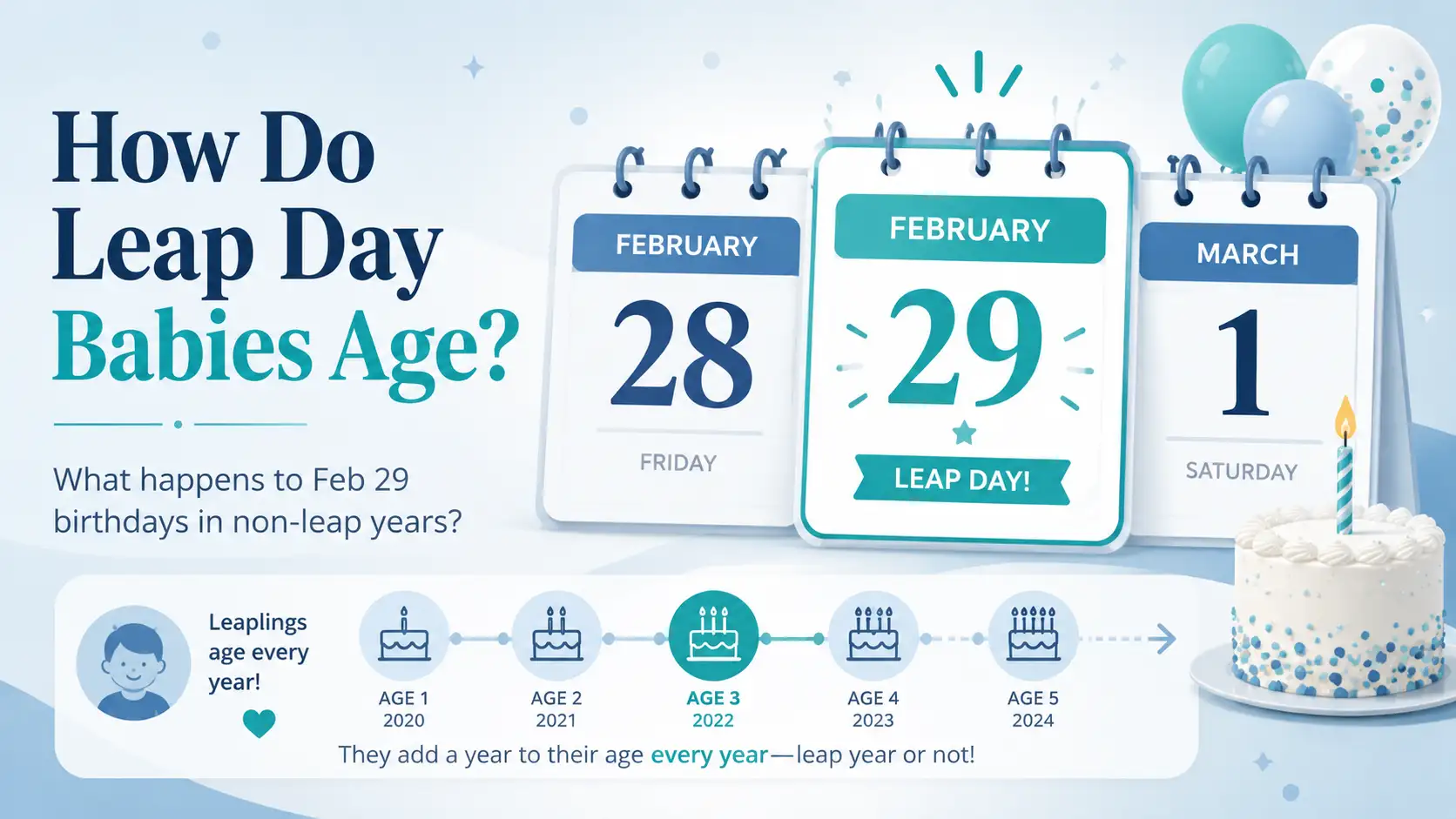
People born on February 29 are sometimes called “leaplings” or “leap day babies,” and they face a genuinely unusual calendar problem: their actual birth date only exists once every four years. So what happens the other three years? Do they age normally? Do birthdays get skipped? Here is exactly how it works, mathematically, legally, and culturally.
Key Takeaways
- People born on February 29 still age normally every year. Only their exact calendar anniversary is missing in non-leap years.
- Most people born on leap day celebrate their birthday on either February 28 or March 1 in non-leap years, depending on personal or regional preference.
- Legally, most jurisdictions still recognize a specific “legal birthday” for age-based rights and requirements, even in years when February 29 does not exist. The exact rule (February 28 vs March 1) varies by country and by the specific law involved.
- A leapling turns one year older every year regardless of whether their exact date appears on the calendar that year.
- Age calculators need explicit logic to handle this edge case correctly, since a naive date comparison can produce errors around late February.
The Basic Problem: A Birthday That Doesn’t Exist Most Years
February 29 only appears in leap years, which occur roughly once every four years under the leap year rules behind this. That means someone born on February 29 has an actual calendar anniversary in only about 1 out of every 4 years. In the other 3 years, the date simply does not exist on the calendar at all, since February only runs through the 28th.
This creates two separate questions that are easy to conflate but are actually distinct: when does a leapling celebrate their birthday, and when does their age legally or technically increment? The answers do not always match.
Does a Leapling Still Age Every Year?
Yes, unambiguously. Time passes at the same rate for everyone regardless of what the calendar looks like. A person born on February 29, 2000 is the same number of years old as anyone else born in early 2000, no matter whether the current year happens to have a February 29 or not. The “missing date” is a calendar quirk, not a pause in aging.
When Do Leaplings Celebrate Their Birthday?
| Convention | Logic | Where It’s Common |
|---|---|---|
| February 28 | Treats the birthday as falling on the last day of February, staying within the same month | Common personal preference; used in some legal contexts |
| March 1 | Treats the birthday as falling on the day immediately after where February 29 would have been | Common personal preference; used in some legal contexts, notably parts of the UK |
| Wait for the next leap year | Only truly “celebrate” on the actual date every 4 years, with informal recognition in between | A minority personal choice, often combined with one of the two dates above for practical purposes |
There is no single universal rule. It largely comes down to personal preference, unless a specific law or contract specifies otherwise.
How Age Calculators Should Handle This Edge Case
A correctly built age calculator needs explicit logic for February 29 birth dates, because a naive comparison between “today’s month and day” and “birth month and day” can behave unpredictably when February 29 does not exist in the current year. The standard approach:
| Step | Action |
|---|---|
| 1 | Check whether the current year is a leap year |
| 2 | If it is, compare against February 29 exactly as with any other birth date |
| 3 | If it is not, substitute a fallback anniversary date, most commonly March 1, for the comparison |
| 4 | Use that fallback consistently every non-leap year so the calculated age never skips or double-counts a year |
| 5 | Display the exact age normally, since the person’s true age is never actually ambiguous, only the display date is |
Worked Examples
Example 1: The Standard Leap Year Case
Someone born on February 29, 2000 is measured on February 29, 2024, which is a leap year. The date exists normally, so the calculation is straightforward: 2024 minus 2000 equals 24 years old exactly on that date.
Example 2: A Non-Leap Year, Using the March 1 Convention
The same person is measured on March 1, 2025, a non-leap year. Using the March 1 fallback convention, this is treated as their “anniversary” for the year, making them 25 years old starting March 1, 2025. On February 28, 2025, they would still be considered 24, since their anniversary (under this convention) has not yet occurred.
Example 3: A Legal Edge Case
Consider someone born February 29, 2008 who needs to know the exact date they become legally eligible for something requiring them to turn 18, in a non-leap year like 2026. If the relevant law uses the February 28 convention, they become legally 18 starting February 28, 2026. If the law instead uses the March 1 convention, they are not legally 18 until March 1, 2026, a one-day difference that can matter for time-sensitive eligibility, such as licensing exams or enrollment deadlines. This is exactly the kind of detail worth confirming directly with the relevant authority rather than assuming.
Comparison: Leapling Birthdays vs Standard Birthdays
| Aspect | Standard Birthday | Leap Day Birthday (Feb 29) |
|---|---|---|
| Exact calendar date exists every year | Yes | No, only in leap years |
| Aging still occurs annually | Yes | Yes |
| Celebration date | Fixed, same date every year | Varies by convention (Feb 28 or March 1) in non-leap years |
| Legal age increment date | Fixed, same date every year | Depends on jurisdiction and specific law |
| Calculator logic required | Simple date comparison | Explicit leap year check with fallback date |
Common Mistakes People Make
| Mistake | Why It’s Wrong | The Fix |
|---|---|---|
| Assuming a leapling only ages once every 4 years | Aging is continuous and universal; only the calendar date is intermittent | Recognize that a leapling’s age increases every single year like anyone else’s |
| Assuming there is one universal rule for the “real” birthday | Different countries, institutions, and even individuals use February 28 or March 1 inconsistently | Check the specific context (legal, cultural, personal) before assuming a date |
| Building a calculator without a leap year check | Comparing to a nonexistent February 29 in a non-leap year can cause errors or incorrect date logic | Explicitly test whether the current year is a leap year and apply a documented fallback date |
| Assuming legal age increments always match personal birthday celebrations | A person might celebrate on March 1 but be legally considered a year older starting February 28, or vice versa, depending on local law | Separate the “celebration” question from the “legal age” question and check each independently |
| Assuming leap day birthdays are extremely rare | While uncommon, roughly 1 in 1,461 people are born on February 29, meaning millions of leaplings exist worldwide | Treat this as a real, recurring edge case worth handling properly rather than an obscure novelty |
A Note on Methodology
This guide follows the standard Gregorian calendar leap year rule described in our leap year age calculation guide, and reflects commonly documented conventions (February 28 and March 1) for handling leap-day anniversaries in non-leap years. Specific legal treatment varies by jurisdiction, so readers with a time-sensitive legal question should confirm with the relevant local authority.
Frequently Asked Questions
What is a person born on February 29 called?
They are commonly called a “leapling” or “leap day baby.”
Do leaplings age slower than everyone else?
No. They age at the exact same rate as anyone else. Only their calendar anniversary date is intermittent, not their actual aging process.
When do most leaplings celebrate their birthday in non-leap years?
Most commonly on either February 28 or March 1, depending on personal preference or regional convention. There is no single universal standard.
Is turning 18 or 21 different for someone born on leap day?
The legal age increment date in non-leap years depends on the specific jurisdiction and law involved, and typically falls on either February 28 or March 1. It is worth confirming with the relevant authority if the exact date matters for something time-sensitive.
How rare is it to be born on February 29?
Roughly 1 in 1,461 people are born on this date, since it only occurs once every 4 years (with rare century-year exceptions).
Does every calculator handle February 29 birthdays correctly?
Not necessarily. A calculator needs specific logic to check whether the current year is a leap year and apply a consistent fallback date; otherwise it can produce inconsistent or incorrect results in non-leap years.
Do leap day birthdays exist in every calendar system?
This guide covers the Gregorian calendar, which is the internationally standard civil calendar. Other calendar systems (lunar, Julian, etc.) have their own separate leap adjustments and are outside the scope here.
How can I find my exact age if I was born on February 29?
The most reliable way is to use a calculator built to handle this specific edge case correctly rather than doing manual date math. You can see how your age would be calculated using our free calculator.
One thought on “What Happens If You’re Born on February 29?”