Key Takeaways
- There is no single legal age that makes someone a “senior citizen.” The label shifts depending on which benefit, discount, or program you’re looking at.
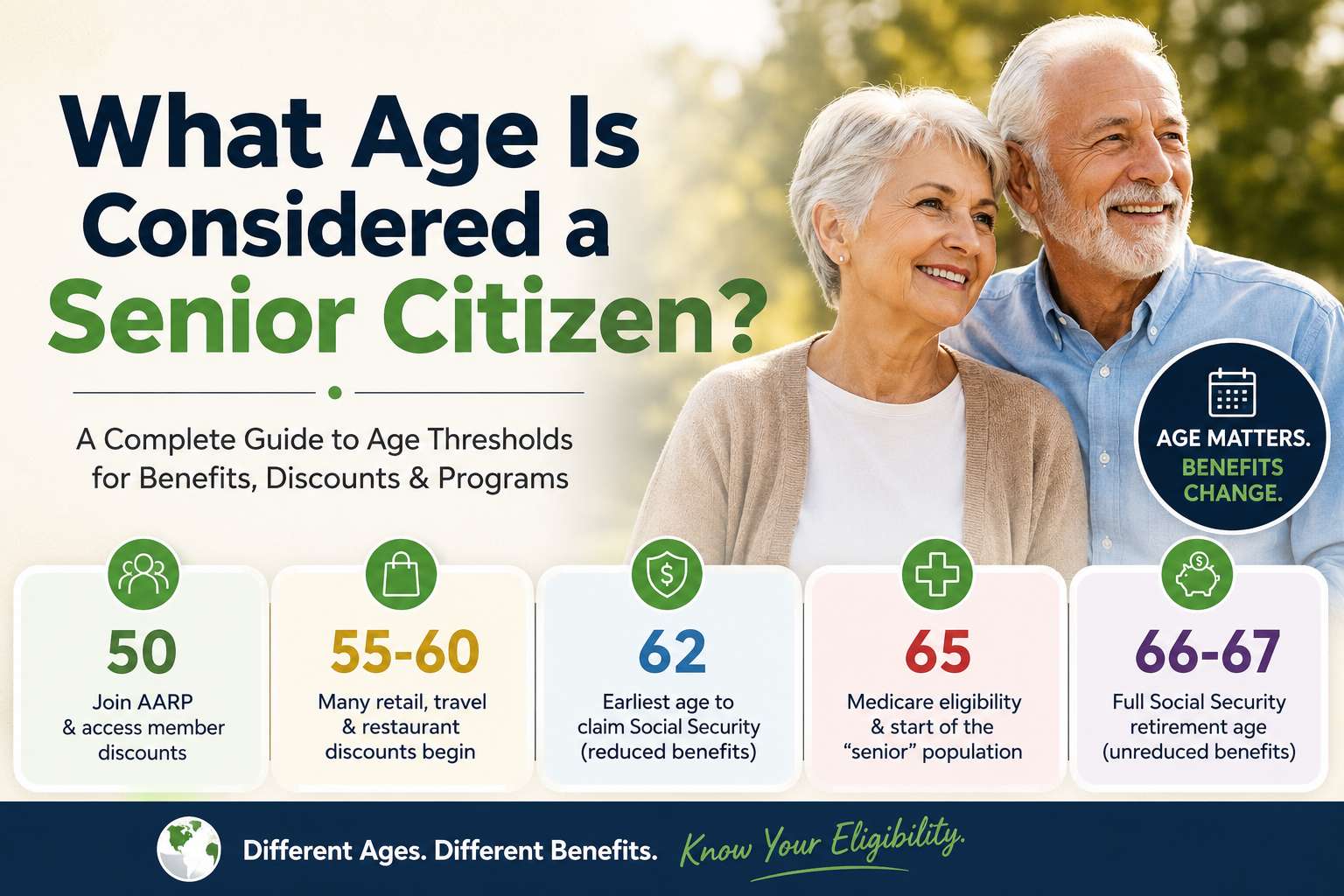
- In the United States, the most commonly cited thresholds are 62 (earliest Social Security claiming age), 65 (Medicare eligibility, and the age the U.S. Census uses to define the senior population), and 55-60 (when many retail and travel discounts begin).
- Other countries set their own thresholds: 60 in India and China, around 65 in Japan, and roughly 66 in the UK, tied to the state pension age.
- Senior citizen age and retirement age are related but not identical. You can be retired before you’re officially a “senior,” or considered a senior while still working.
- Knowing your exact age, not just your birth year, is what actually determines eligibility for most of these programs, since many are calculated from your specific date of birth.
There Is No Universal Definition
“Senior citizen” is a social and administrative label, not a legal category with one fixed age. Governments, businesses, and nonprofits each define it based on the purpose of their own program:
- Government benefit programs (pensions, Medicare, Social Security) set thresholds based on actuarial and budget calculations.
- Retail and travel discounts often set a lower age, sometimes as young as 50 or 55, as a marketing and loyalty tool rather than a policy decision.
- Healthcare and social services may use 60 or 65 as the point where additional support programs become available.
- Cultural and social usage of “senior” or “elderly” is subjective and varies by country, generation, and even individual attitude toward aging.
Senior Citizen Age Thresholds by Context (United States)
| Age | What Happens at This Age |
|---|---|
| 50 | Eligible to join AARP and access many of its member discounts |
| 55-60 | Many restaurant, retail, and hotel senior discounts begin |
| 62 | Earliest age to claim Social Security retirement benefits, at a reduced monthly amount |
| 65 | Medicare eligibility begins; the U.S. Census defines this as the start of the “senior” population |
| 66-67 | Full Social Security retirement age (depending on birth year), unlocking unreduced benefits |
Because these thresholds don’t align, someone can be an AARP member at 50, eligible for a movie discount at 55, and still eight to fifteen years away from Medicare or full Social Security.
Senior Citizen Age Around the World
| Country | Common Senior Citizen Threshold | Notes |
|---|---|---|
| United States | 65 (Medicare); 62 (early Social Security) | No single legal definition |
| United Kingdom | Around 66 | Tied to the state pension age, which is gradually increasing |
| India | 60 | Legal definition under the Maintenance and Welfare of Parents and Senior Citizens Act |
| China | 60 (men), 50-55 (women, depending on occupation) | Tied closely to statutory retirement age |
| Japan | 65 | Common threshold for discounts and the “Silver Human Resources” employment support system |
| Most of Western Europe | 60-65 | Often aligned with each country’s state pension age |
Worked Examples
Example 1: A 55-year-old in the United States. This person can already join AARP, likely qualifies for some restaurant and retail senior discounts, but is still seven years from Medicare eligibility and cannot yet claim Social Security. They are a “senior” for some purposes and not for others, simultaneously.
Example 2: A 62-year-old choosing between claiming Social Security now or waiting. Claiming at 62 is allowed but comes with a permanent reduction, often around 25 to 30 percent less than waiting until full retirement age. This is the classic edge case: being old enough to qualify does not mean it’s the financially optimal choice.
Example 3: A 60-year-old in India versus a 60-year-old in the United States. In India, this person is legally a senior citizen under national law, with defined rights and protections. In the United States, the same age qualifies for some private discounts but not for Medicare or full Social Security, showing how the same birthday can mean very different things depending on country.
Senior Citizen Age vs. Retirement Age vs. Legal Adulthood
| Concept | Typical Age | Governs |
|---|---|---|
| Legal age of adulthood | 18 (most countries) | Legal rights and contracts |
| Senior citizen age | 55-65, varies widely | Discounts, healthcare, social recognition |
| Statutory retirement age | 60-70 | Pension eligibility, workforce policy |
These three ages sit at very different points in life and are set by entirely different authorities, so it’s worth treating them as separate questions rather than assuming one determines the others. For a closer look at how retirement thresholds compare across countries, see how this compares to retirement age rules.
Common Mistakes About Senior Citizen Age
| Mistake | Why It’s Wrong | The Fix |
|---|---|---|
| Assuming there’s one legal “senior citizen age” | The threshold depends entirely on the program or benefit in question | Check the specific program’s own eligibility rules |
| Confusing senior citizen age with Medicare eligibility | Medicare in the U.S. starts at 65, but many other senior benefits start earlier or later | Separate healthcare eligibility from discount eligibility |
| Assuming retirement and senior status happen at the same age | You can retire early and not yet be a “senior,” or vice versa | Check each threshold independently for your situation |
| Ignoring country differences | Senior citizen age in India (60) is not the same as in the U.S. or UK | Always check the specific country’s definition |
| Assuming discount eligibility means government benefit eligibility | Retail discounts are set by businesses, not law | Confirm program type before assuming broader eligibility |
Why Your Exact Age Matters Here
Since so many of these thresholds are exact ages rather than approximate life stages, knowing your precise age down to the day, not just your birth year, is genuinely useful when checking eligibility windows for Medicare, Social Security, or a senior discount program. Check your exact age here to see precisely how far you are from any of the milestones above.
It’s also worth understanding how your senior citizen status relates to your country’s retirement rules specifically, since the two are frequently, and incorrectly, treated as the same thing. See how this compares to retirement age rules for a full country-by-country breakdown.
Frequently Asked Questions
What age is officially considered a senior citizen in the US?
There’s no single legal definition, but 65 is the most widely used threshold, since it aligns with Medicare eligibility and the U.S. Census Bureau’s definition of the senior population.
At what age do senior discounts start?
This varies by business, but many retail, restaurant, and travel discounts begin between 50 and 60, well before the more formal 65 threshold.
Is 60 considered a senior citizen?
In some countries, including India and China, yes, 60 is the legally recognized senior citizen age. In the United States, 60 typically qualifies for some private discounts but not Medicare.
What’s the difference between senior citizen age and retirement age?
Retirement age determines when you can claim a pension; senior citizen age determines eligibility for discounts, benefits, or social recognition. They frequently don’t match.
Can you be a senior citizen without being retired?
Yes. Many people continue working well past the age that qualifies them for senior discounts or even Medicare eligibility.
Does senior citizen age affect Social Security benefits?
Not directly. Social Security eligibility is governed by its own age rules (62 for early claiming, 66-67 for full benefits), separate from any general “senior citizen” label.
Why do senior discounts start at different ages at different businesses?
Discount age thresholds are set individually by each business as a marketing and customer loyalty decision, not by law, which is why they vary so widely.
Is there a global standard senior citizen age?
No. Definitions range from 50 (for some membership programs) to 65 (for most government healthcare and pension-linked programs), and vary further by country.
Methodology Note
Age thresholds referenced in this guide reflect current program rules for Social Security, Medicare, and comparable international senior citizen definitions at the time of publication. Program rules, especially Medicare and Social Security ages, can change with legislation, so always confirm current eligibility ages with the relevant government agency before making financial decisions.
One thought on “What Age Is Considered a Senior Citizen?”