Key Takeaways
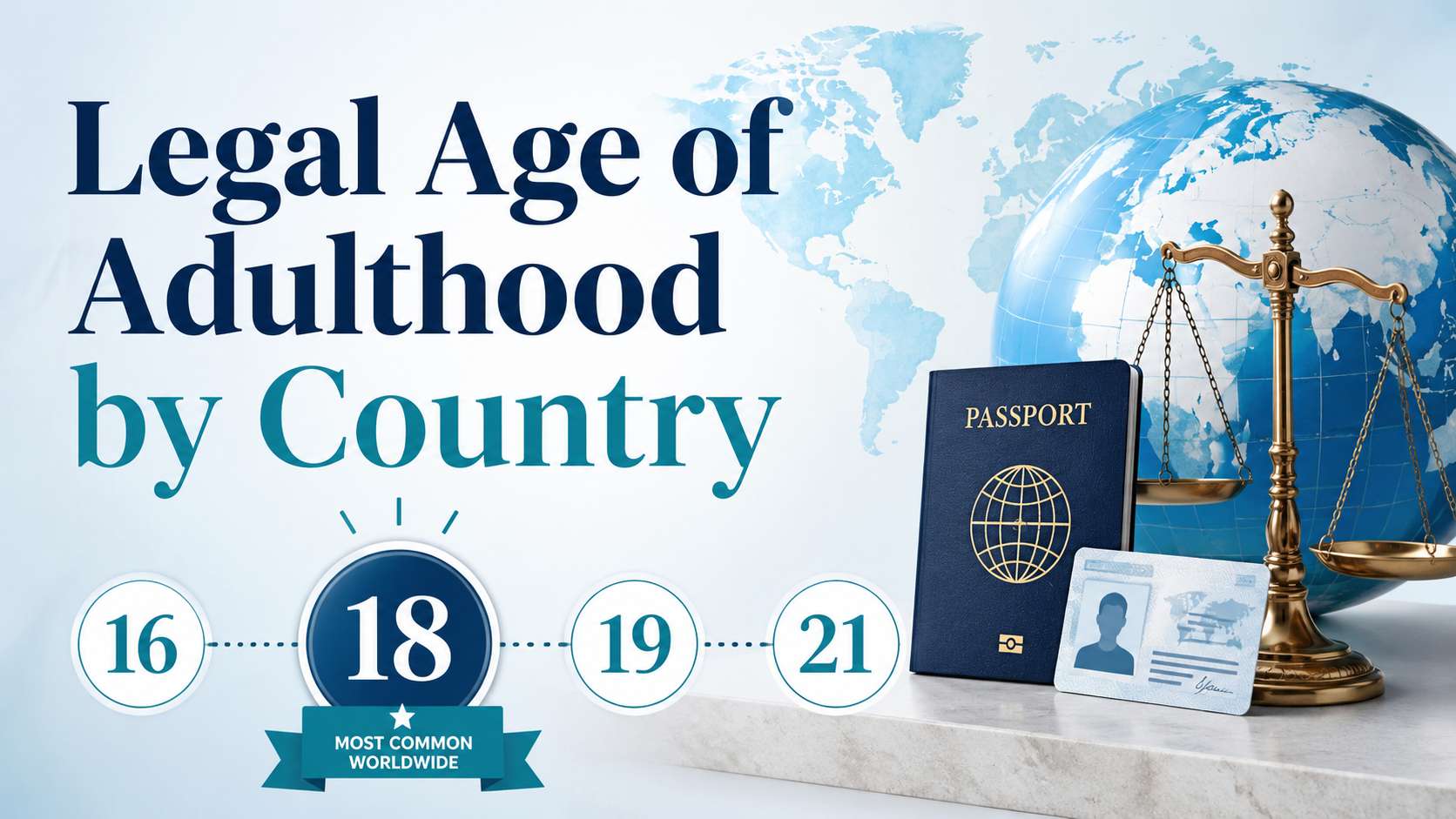
- The age of majority, the legal age of adulthood, is 18 in the overwhelming majority of countries worldwide.
- A small number of countries set it higher: 21 in Mozambique, Kuwait, Cameroon, and the United Arab Emirates.
- A handful set it lower: 16 in Vietnam, Myanmar, Cambodia, and Cuba, and famously 16 in Scotland while the rest of the UK uses 18.
- Age of majority is a legal umbrella term. It doesn’t automatically set the voting age, drinking age, or age of consent, which are frequently set separately, sometimes higher and sometimes lower.
- Emancipation allows some minors to gain adult legal status early, most commonly through marriage, military service, or a court order.
What “Age of Majority” Actually Means
The age of majority is the point at which the law stops treating someone as a minor and starts recognizing them as a fully responsible adult: able to sign binding contracts, sue or be sued in their own name, manage their own property, and make independent legal decisions without parental consent.
It’s important to separate this from other age-based rights that often get bundled into the same conversation:
- Voting age: the minimum age to vote in elections, commonly 18 but occasionally lower (16 in a few countries and jurisdictions).
- Age of consent: the minimum age for legal sexual consent, which varies significantly by country and is governed by entirely separate laws.
- Drinking and smoking age: often set higher than the age of majority (21 for alcohol in the United States, for example, despite an 18 age of majority in most states).
- Criminal responsibility age: the age at which a person can be tried and sentenced as an adult, which sometimes differs from the general age of majority.
Age of Majority by Country: A Comparison
| Age of Majority | Countries (illustrative) |
|---|---|
| 21 | Mozambique, Kuwait, Cameroon, United Arab Emirates, Singapore, Egypt |
| 19 | South Korea, some Canadian provinces (British Columbia, Nunavut, Newfoundland and Labrador) |
| 18 | Most of the world, including the United States (with a few state exceptions), most of the European Union, Australia, Japan, Brazil, India |
| 17 | North Korea, Timor-Leste |
| 16 | Scotland, Vietnam, Myanmar, Cambodia, Cuba |
Eighteen is the age of majority in nearly every OECD member country, making it one of the most globally standardized legal thresholds anywhere in law. That said, the details within “18” still vary: some rights attached to adulthood (voting, marrying without consent, signing certain contracts) can kick in slightly before or after that birthday depending on local statute.
Worked Examples
Example 1: An 18-year-old in Germany. They become a full legal adult on their 18th birthday, gaining the right to vote, sign contracts, and marry without parental consent, all at once, since Germany aligns these rights with its single age of majority.
Example 2: A 19-year-old in South Korea. Under Korean age reckoning reform and current civil law, this person only just reached the age of majority, one year later than most of their international peers, which matters for anything requiring cross-border legal recognition, such as signing an international contract or opening certain accounts abroad.
Example 3: A 17-year-old who marries in a jurisdiction that allows it. In many legal systems, marriage before reaching the general age of majority triggers automatic emancipation, meaning this person gains full adult legal status even though they haven’t yet reached the standard threshold, and they do not revert to minor status even if the marriage later ends. This is the key edge case in age of majority law: the general rule has built-in exceptions.
Age of Majority vs. Related Legal Ages
| Right or Status | Typical Age | Same as Age of Majority? |
|---|---|---|
| Age of majority (general adulthood) | 18 (most common) | N/A, this is the baseline |
| Voting age | 18 (commonly), 16 in some countries | Usually matches, not always |
| Legal drinking age | 18-21, varies widely | Often does not match |
| Age of consent | 14-18, varies significantly by country | Rarely matches exactly |
| Driving age (learner’s permit) | 15-18, varies by country/state | Usually earlier than age of majority |
| Voting age is covered in more detail in What Age Can You Legally Vote? (By Country) |
Common Mistakes About Age of Majority
| Mistake | Why It’s Wrong | The Fix |
|---|---|---|
| Assuming age of majority is 18 everywhere | Several countries set it at 16, 19, or 21 | Check the specific country before assuming |
| Treating age of majority and voting age as identical | They’re set by separate laws and can differ | Verify each right independently |
| Assuming adulthood always starts on the birthday itself | Some jurisdictions count differently (e.g., the day before the birthday in parts of English common law tradition) | Check local legal convention for exact timing |
| Ignoring emancipation exceptions | Marriage, military service, or court orders can grant adult status before the general age of majority | Consider whether an exception applies to the specific case |
| Assuming age of majority determines drinking or driving age | These are typically set independently, often higher | Check each right separately, especially for alcohol and driving |
Why Your Exact Age Matters Here
Since so many of these legal thresholds are calculated to the exact day of a birthday, not just the year, it’s worth knowing precisely how old you are and how many days remain until a specific milestone. Verify your exact current age if you’re checking eligibility for any age-of-majority-linked right.
Age of majority is also just one of several age-based rights and milestones worth understanding together. Voting rights are a closely related milestone: see one of the rights tied to adulthood for a full breakdown of voting age by country.
Frequently Asked Questions
What is the legal age of adulthood in most countries?
Eighteen is the most common age of majority worldwide, recognized by nearly every OECD country and the majority of nations globally.
Which countries have an age of majority higher than 18?
Mozambique, Kuwait, Cameroon, and the United Arab Emirates all set the age of majority at 21, among others.
Which countries have an age of majority lower than 18?
Vietnam, Myanmar, Cambodia, and Cuba set it at 16, as does Scotland within the United Kingdom, while North Korea and Timor-Leste use 17.
Is age of majority the same as voting age?
Usually, but not always. Some countries allow voting before the general age of majority, such as at 16, while the broader legal adult status still begins at 18.
What is emancipation?
Emancipation is a legal process, or automatic result of events like marriage or military enlistment, that grants a minor full adult legal status before they reach the standard age of majority.
Does age of majority affect the drinking age?
Not directly. Many countries, including the United States, set the drinking age higher (21) than the general age of majority (18).
Why is the age of majority different in Scotland than the rest of the UK?
Scotland has historically used 16 as its age of legal capacity for most purposes, a distinction that has persisted through devolution and separate Scottish civil law.
Can the age of majority change for someone already born?
Generally no. Reforms to the age of majority typically apply going forward, not retroactively, to people who have already reached adulthood under the prior rule.
Methodology Note
Age of majority figures in this guide reflect the most recently reported statutory thresholds by country as of publication, drawn from national civil codes and comparative legal databases. Because a small number of countries have hybrid rules (differing ages for specific rights within the general adulthood threshold), always confirm the exact right in question against current local law before relying on any single number.