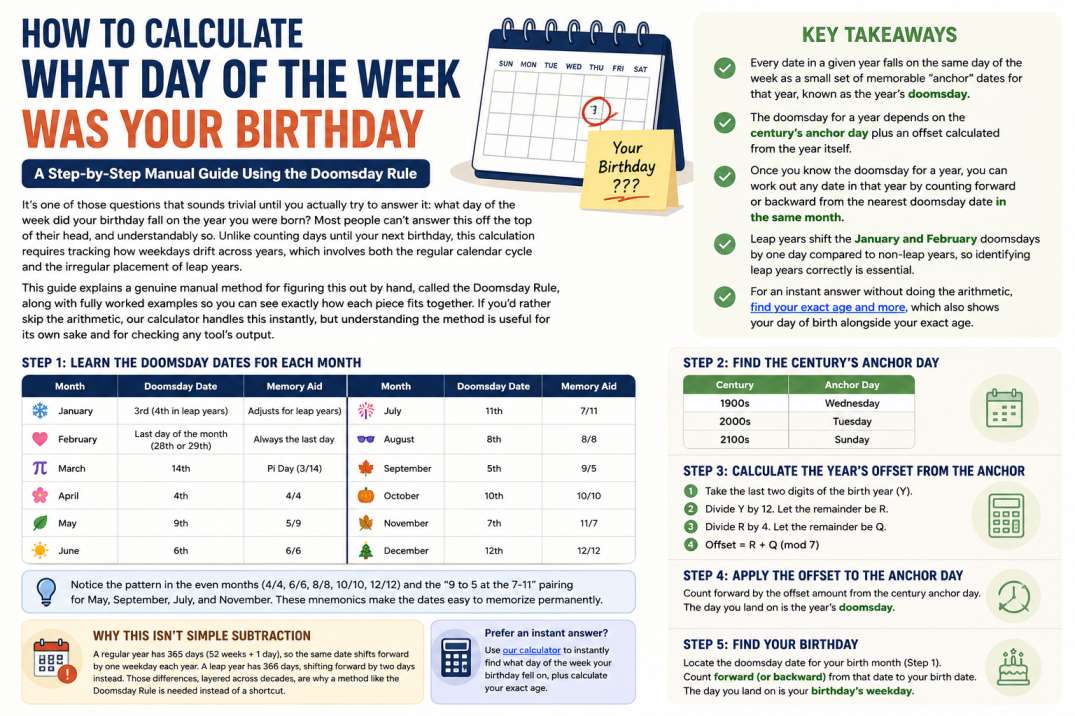
It’s one of those questions that sounds trivial until you actually try to answer it: what day of the week did your birthday fall on the year you were born? Most people can’t answer this off the top of their head, and understandably so. Unlike counting days until your next birthday, this calculation requires tracking how weekdays drift across years, which involves both the regular calendar cycle and the irregular placement of leap years.
This guide explains a genuine manual method for figuring this out by hand, called the Doomsday Rule, along with fully worked examples so you can see exactly how each piece fits together. If you’d rather skip the arithmetic, our calculator handles this instantly, but understanding the method is useful for its own sake and for checking any tool’s output.
Key Takeaways
- Every date in a given year falls on the same day of the week as a small set of memorable “anchor” dates for that year, known as the year’s doomsday.
- The doomsday for a year depends on the century’s anchor day plus an offset calculated from the year itself.
- Once you know the doomsday for a year, you can work out any date in that year by counting forward or backward from the nearest doomsday date in the same month.
- Leap years shift the January and February doomsdays by one day compared to non-leap years, so identifying leap years correctly is essential.
- For an instant answer without doing the arithmetic, find your exact age and more, which also shows your day of birth alongside your exact age.
Why This Isn’t Simple Subtraction
Days until a birthday can be worked out with straightforward month-length arithmetic, because you’re measuring a gap within a single continuous stretch of the calendar. Figuring out a day of the week is different, because the calendar doesn’t repeat on a clean weekly cycle from year to year. A regular year has 365 days, which is 52 weeks plus 1 day, so each subsequent year the same calendar date shifts forward by one day of the week. A leap year has 366 days, which shifts things forward by two days instead of one. Those two different shift amounts, layered across decades, are what make this calculation genuinely require a method rather than a shortcut.
The Doomsday Rule: A Manual Method
The Doomsday Rule, developed by mathematician John Conway, is built around a simple observation: a specific set of dates always falls on the same day of the week within any single year. That shared weekday is called the year’s “doomsday.” Once you know it, you can calculate the weekday of any other date in that year by counting forward or backward from the closest doomsday date.
Step 1: Learn the Doomsday Dates for Each Month
| Month | Doomsday Date | Memory Aid |
|---|---|---|
| January | 3rd (4th in leap years) | Adjusts for leap years |
| February | Last day of the month (28th or 29th) | Always the last day |
| March | 14th | Pi Day (3/14) |
| April | 4th | 4/4 |
| May | 9th | 5/9 |
| June | 6th | 6/6 |
| July | 11th | 7/11 |
| August | 8th | 8/8 |
| September | 5th | 9/5 |
| October | 10th | 10/10 |
| November | 7th | 11/7 |
| December | 12th | 12/12 |
Notice the pattern in the even months (4/4, 6/6, 8/8, 10/10, 12/12) and the “9 to 5 at the 7-11” pairing for May, September, July, and November. These mnemonics make the dates easy to memorize permanently.
Step 2: Find the Century’s Anchor Day
Each century has a fixed anchor weekday that all its doomsdays are built from.
| Century | Anchor Day |
|---|---|
| 1900s | Wednesday |
| 2000s | Tuesday |
| 2100s | Sunday |
Nearly every living reader was born in the 1900s or 2000s, so these two rows cover almost every case.
Step 3: Calculate the Year’s Offset from the Anchor
Take the last two digits of the birth year (call this Y) and apply this sequence:
- Divide Y by 12 and keep only the whole number (call this a).
- Find the remainder of Y divided by 12 (call this b).
- Divide b by 4 and keep only the whole number (call this c).
- Add a + b + c, then find the remainder when divided by 7. This is the offset.
Step 4: Apply the Offset to the Century Anchor
Count forward from the century’s anchor day by the number of days in the offset. This gives you the doomsday weekday for that specific year.
Step 5: Count from the Nearest Doomsday to Your Actual Date
Find the doomsday date in the same month as your birth date, then count forward or backward the number of days to reach your actual date, moving the same number of weekdays forward or backward from the doomsday’s weekday.
Worked Example 1: A Standard Case
Let’s calculate the day of the week for July 20, 1990.
- Century anchor: 1990 is in the 1900s, so the anchor is Wednesday.
- Year offset: Y = 90. a = floor(90/12) = 7. b = 90 mod 12 = 6. c = floor(6/4) = 1. Offset = (7 + 6 + 1) mod 7 = 14 mod 7 = 0.
- Doomsday for 1990: Wednesday + 0 = Wednesday.
- Nearest doomsday in July: July 11.
- Distance from July 11 to July 20: 9 days forward.
- Counting forward 9 days from Wednesday: 9 mod 7 = 2, so 2 days forward from Wednesday is Friday.
July 20, 1990 was a Friday.
Worked Example 2: A Leap Year Case
Let’s calculate the day of the week for February 29, 2004.
- Century anchor: 2004 is in the 2000s, so the anchor is Tuesday.
- Year offset: Y = 4. a = floor(4/12) = 0. b = 4 mod 12 = 4. c = floor(4/4) = 1. Offset = (0 + 4 + 1) mod 7 = 5.
- Doomsday for 2004: Tuesday + 5 days = Sunday.
- Nearest doomsday in February: since 2004 is a leap year, the doomsday is February 29 itself, which is the exact date we’re checking.
February 29, 2004 was a Sunday.
This example shows why confirming leap year status matters immediately: if you mistakenly used February 28 as the doomsday instead of February 29, every calculation involving late February or early March in that year would be off by one day.
Worked Example 3: A Date Near a Century Boundary
Let’s calculate the day of the week for January 5, 1900.
- Century anchor: 1900 falls right at the start of the 1900s, so the anchor is Wednesday. Note that 1900 is a special case: even though it’s divisible by 4, it is not a leap year, because century years must be divisible by 400 to qualify (2000 was a leap year, 1900 was not).
- Year offset: Y = 0. a = 0, b = 0, c = 0. Offset = 0.
- Doomsday for 1900: Wednesday + 0 = Wednesday.
- Nearest doomsday in January: since 1900 is not a leap year, the doomsday is January 3.
- Distance from January 3 to January 5: 2 days forward.
- Counting forward 2 days from Wednesday: Friday.
January 5, 1900 was a Friday.
Manual Calculation vs. Using a Calculator
| Factor | Manual Doomsday Method | Online Calculator |
|---|---|---|
| Speed | A minute or two once memorized, longer while learning | Instant |
| Accuracy | High once the century rules and leap years are applied correctly | Handles century and leap year rules automatically |
| Educational value | Teaches genuine calendar structure and mental math | Doesn’t show the underlying logic |
| Common failure point | Forgetting century-year leap year exceptions (like 1900) | None, assuming the tool is built correctly |
| Best for | Trivia, mental math practice, understanding the calendar | Quick, reliable answers without doing arithmetic |
If you’d rather skip the manual steps entirely, find your exact age and more using our calculator, which returns your birth weekday instantly.
Common Mistakes and How to Fix Them
| Mistake | Why It’s Wrong | The Fix |
|---|---|---|
| Treating every year divisible by 4 as a leap year | Century years like 1900 are exceptions to this rule | Check that century years are divisible by 400, not just 4, before treating them as leap years |
| Using the wrong century anchor | Each century has its own distinct anchor weekday | Confirm which century the birth year falls in before starting the offset calculation |
| Forgetting to shift the January and February doomsdays in leap years | These are the only two months whose doomsday date changes based on leap year status | Always check leap year status before applying January or February’s doomsday date |
| Miscounting the distance between the doomsday date and the target date | An off-by-one error here shifts the entire final answer | Count carefully, or use the difference in day-of-month numbers directly when both dates are in the same month |
| Confusing the offset formula’s steps | Skipping or misordering a, b, or c produces the wrong doomsday | Work through a, b, and c in order every time, writing each intermediate result down |
A Note on Methodology
This guide uses the Doomsday Rule as developed by mathematician John Conway, applied under standard Gregorian calendar conventions. The century anchor days shown here (Wednesday for the 1900s, Tuesday for the 2000s) are the standard accepted values for the Gregorian calendar and repeat in a 400-year cycle. For a broader explanation of how leap years fit into this system, see our guide on how leap years affect your age calculation. Once you know your birth weekday, you might also want to try counting down to your next birthday using our related guide on how to calculate days until your next birthday.
Frequently Asked Questions
What day of the week was I born on if I don’t know the exact method? You can use the Doomsday Rule described above, or use an online date calculator that performs the same calculation instantly.
Why do some years shift the weekday by one day and others by two? A standard 365-day year shifts each date forward by one weekday compared to the previous year, since 365 divided by 7 leaves a remainder of 1. A 366-day leap year shifts dates forward by two weekdays instead, since 366 divided by 7 leaves a remainder of 2.
Is the Doomsday Rule accurate for any year in history? It’s accurate for any date under the Gregorian calendar, which was adopted at different times in different countries (starting in 1582 in much of Catholic Europe, later elsewhere). For dates before a country’s Gregorian adoption, a different calendar system applies.
Why was 1900 not a leap year if it’s divisible by 4? Century years follow a stricter leap year rule: they must be divisible by 400, not just 4, to qualify. Since 1900 divided by 400 leaves a remainder, it was not a leap year, while 2000 was.
Can I use this method for a future date, not just a past birth date? Yes. The same steps work for any date, past or future, as long as you correctly identify the century, apply the year offset formula, and check leap year status.
Does the day of the week matter for anything besides trivia? Beyond curiosity, it can matter for things like verifying historical records, planning recurring events, or confirming details on official documents where a discrepancy might indicate an error.
What’s the fastest way to double check my manual calculation? Recalculate using a different doomsday date in the same month as a cross-check. If both approaches agree, your answer is very likely correct.
Is there a simpler shortcut for just this year or a nearby year? Yes, many people memorize the current year’s doomsday directly, since it doesn’t change until the calendar rolls over to the next year, which saves you from recalculating the century anchor and offset every time.