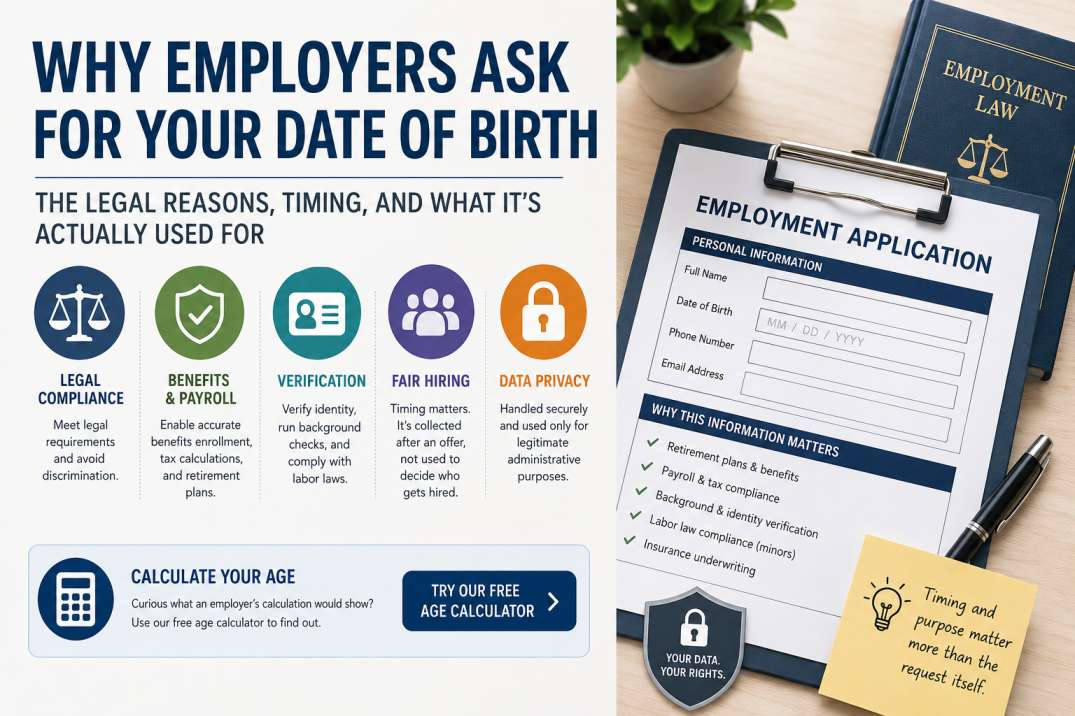
If you’ve ever paused on a job application at the “date of birth” field, wondering why a potential employer needs your exact birth date rather than just confirming you’re over a certain age, you’re not alone. It’s a reasonable question. In most countries, using age to make hiring decisions is restricted or outright illegal, yet asking for a date of birth remains a normal part of onboarding paperwork. The explanation comes down to a handful of legitimate administrative, legal, and benefits-related reasons, most of which have nothing to do with the hiring decision itself.
This guide walks through exactly why employers collect this information, what it’s actually used for once you’re hired, and where the legal lines are drawn between reasonable data collection and unlawful age discrimination.
Key Takeaways
- Employers generally cannot use your exact age to decide whether to hire you, but they often need it for payroll, benefits, and legal compliance once you’re already an employee.
- Common legitimate uses include retirement plan eligibility, minimum wage tier verification for younger workers, background checks, and benefits enrollment like health insurance and life insurance.
- In many jurisdictions, date of birth requests are legally separated from the hiring decision stage and only collected after a conditional offer, specifically to avoid the appearance of age discrimination.
- If a request feels premature, such as being asked for your birth date on an initial application before any offer, it’s worth asking why, since best practice generally defers this to onboarding.
- To calculate age from date of birth yourself and see exactly what an employer’s calculation would show, you can use our free calculator.
The Core Tension: Age Discrimination Law vs. Administrative Need
Most developed countries have some form of age discrimination protection in employment. In the United States, for example, the Age Discrimination in Employment Act protects workers 40 and older from being treated unfavorably because of age in hiring, firing, promotion, and other employment decisions. Similar protections exist in the UK’s Equality Act 2010, Canada’s human rights legislation, and equivalents across the EU.
At the same time, employers have entirely legitimate operational reasons to know your exact date of birth once you’re employed. These two facts sit in tension, which is why the timing and purpose of a date of birth request matters more than the fact that it’s requested at all.
Common Legitimate Reasons Employers Request Date of Birth
| Purpose | Why Exact Date of Birth Is Needed |
|---|---|
| Retirement plan enrollment (401(k), pension schemes) | Contribution limits, vesting schedules, and required minimum distribution ages are tied to exact birth dates |
| Payroll tax and benefits administration | Certain tax credits and benefit thresholds are age-dependent and must be calculated precisely |
| Minor labor law compliance | Workers under 18 (or the relevant local age) are subject to different wage rules, hour restrictions, and hazardous work limitations |
| Health insurance enrollment | Insurers use exact age to calculate premiums and eligibility for dependent coverage |
| Life and disability insurance | Underwriting for employer-provided policies is age-based |
| Background checks | Identity verification services use date of birth to confirm you match the correct record among people with similar names |
| Government reporting requirements | Some public sector or government-contracted roles require birth date verification for security clearance or reporting purposes |
Step-by-Step: When Date of Birth Requests Should Happen in the Hiring Process
| Stage | Should Date of Birth Be Requested? | Reasoning |
|---|---|---|
| Initial job application | Generally no | Requesting it here risks the appearance of using age as a screening factor before qualifications are even reviewed |
| Interview stage | Generally no | Same reasoning as above; interviewers are typically trained to avoid asking directly about age |
| Conditional offer extended | Sometimes, for specific legal checks | At this stage, some background check or licensing requirements may need it |
| Onboarding after acceptance | Yes, commonly | This is the standard point for payroll, benefits, and tax paperwork that requires exact birth date |
| Ongoing employment records | Yes, maintained on file | Needed for the lifetime of employment for the reasons listed in the table above |
Worked Example 1: A Straightforward Onboarding Case
Maria accepts a job offer and, during her first week, fills out standard onboarding paperwork including her date of birth. The company uses this to enroll her in the 401(k) plan (which has age-based catch-up contribution rules starting at 50), set up her health insurance (where dependents’ ages also matter for coverage tiers), and confirm she meets the minimum age requirement for a state-mandated safety certification tied to her specific role. None of this involved her age being used to decide whether she was hired, since that decision was made and finalized before any birth date was collected.
Worked Example 2: A Red Flag Case
James applies for an entry-level position and notices the online application form requires a date of birth field before he can even submit his resume, with no way to skip it. This is a legitimate reason for caution, since no legal payroll or benefits process should require birth date information at the initial application stage. This doesn’t necessarily mean the employer intends to discriminate, since some outdated application software templates simply include the field by default, but it’s a reasonable thing to raise with a recruiter or HR contact before proceeding, especially in jurisdictions with strict age discrimination enforcement.
Worked Example 3: A Minor Employment Case
A 16-year-old applies for a part-time retail position. In this specific situation, the employer legitimately needs to know the applicant’s exact age (and therefore date of birth) even before an offer, because many jurisdictions restrict the types of work, number of hours, and time of day minors are permitted to work. This is one of the narrow, legally recognized exceptions where earlier collection of birth date information is justified rather than a red flag.
Comparison: Legitimate Requests vs. Concerning Requests
| Factor | Legitimate Request | Concerning Request |
|---|---|---|
| Timing | After a conditional offer or during onboarding | Required on the initial application before any offer |
| Stated purpose | Tied to a specific administrative need (benefits, payroll, legal compliance) | No explanation given, or vague reference to “company policy” |
| Optionality | Often collected alongside other legally required onboarding forms | Mandatory field blocking submission of an initial application |
| Context | Matches a known legal requirement (minors, retirement plans, benefits) | No apparent legal or administrative justification |
| Who asks | HR or payroll department after hire | Hiring manager or interviewer during the interview itself |
How This Varies by Country
Employment law around date of birth collection isn’t uniform worldwide. The table below gives a general sense of how a few major jurisdictions typically approach this, though individual states, provinces, and industries can carve out their own exceptions.
| Country/Region | General Approach | Notable Detail |
|---|---|---|
| United States | Federal law (ADEA) protects workers 40+ from age discrimination; many states add their own broader protections | Applications commonly omit date of birth fields entirely until after a conditional offer, to reduce legal exposure |
| United Kingdom | Equality Act 2010 prohibits age discrimination across all adult ages, not just older workers | Employers are generally advised not to request date of birth on initial applications at all |
| Canada | Human rights codes vary by province but generally prohibit age-based hiring discrimination | Federally regulated employers often follow guidance similar to the US in deferring birth date collection |
| European Union | EU Employment Equality Directive sets a baseline against age discrimination, implemented differently by member state | National implementations vary in how strictly pre-offer birth date requests are treated |
| Australia | Age discrimination is prohibited under both federal and state legislation | Similar deferred-collection practice is common among larger employers |
If you’re applying for a role in a country with unfamiliar labor law, and a date of birth request seems unusual for the stage of the process you’re in, checking that country’s specific age discrimination legislation, or asking HR directly, is a reasonable next step.
Common Mistakes and Misunderstandings
| Mistake | Why It’s Wrong | The Fix |
|---|---|---|
| Assuming any date of birth request is discriminatory | Most requests are for legitimate post-hire administrative reasons | Consider the timing and stated purpose before assuming bad intent |
| Refusing to provide date of birth during legitimate onboarding | This can delay benefits enrollment, payroll setup, and legal compliance processes that protect you | Provide the information once an offer is accepted, through official onboarding channels |
| Giving birth date information through informal or unsecured channels | Sensitive personal data sent by casual email or text message is more vulnerable to exposure | Only provide this information through official HR systems or verified onboarding portals |
| Not asking why birth date is required at the application stage | Silence can allow a genuinely outdated or discriminatory process to continue unchallenged | Politely ask HR or the recruiter why the field is required if it appears before an offer |
| Confusing age verification with age discrimination | Verifying age for legal reasons (like minor labor laws) is different from using age to decide who gets hired | Distinguish between administrative verification and hiring criteria before raising concerns |
A Note on Methodology
This guide reflects generally accepted employment law principles across common law jurisdictions including the United States, United Kingdom, and Canada, and reflects standard HR industry practice regarding the timing of sensitive data collection. Specific rules vary by country and by state or province, so this guide should be treated as a general explanation rather than legal advice for any particular jurisdiction. For more detail on what happens to this information once collected, see our related guide on how this data is actually used. Date of birth verification also comes up outside employment, which we cover in our guide on verifying age in other contexts.
Frequently Asked Questions
Can an employer legally ask for my date of birth on a job application? This depends on jurisdiction and context. In many places, it’s discouraged or restricted at the application stage specifically because it could be used to infer age before qualifications are assessed, though it becomes standard and expected during onboarding after a job offer.
What happens if I refuse to give my date of birth to my employer? Refusing during legitimate onboarding can delay or block enrollment in retirement plans, health insurance, and other benefits that require exact age calculations, and it may also prevent required legal compliance checks depending on your role.
Is it illegal for an employer to ask how old I am? Directly asking your age during an interview is generally discouraged and, in some jurisdictions, restricted, since it could suggest age is being used as a hiring factor. This is different from an HR department requesting date of birth for administrative purposes after you’ve been hired.
Why do minors have different rules around this? Labor laws in most countries restrict the hours, conditions, and types of work minors can perform, so verifying a candidate’s exact age before or during hiring is a recognized legal exception for underage applicants.
Do background check companies need my exact date of birth? Yes, typically. Background check providers use date of birth alongside your name to correctly match your record and avoid confusing you with another person who shares your name.
Does providing my date of birth put me at risk of identity theft? Date of birth is one piece of information sometimes used in identity verification, so it should only be shared through secure, official channels rather than informal ones, similar to how you’d treat other sensitive personal information.
Can I ask my employer why they need my date of birth? Yes, and doing so is reasonable. A legitimate employer should be able to explain the administrative or legal purpose behind the request without hesitation.
Is there a difference between date of birth and age verification requirements? Date of birth is the underlying data point; age verification is the broader process of confirming someone meets an age-related requirement, which might use date of birth, ID documents, or other methods depending on the context.