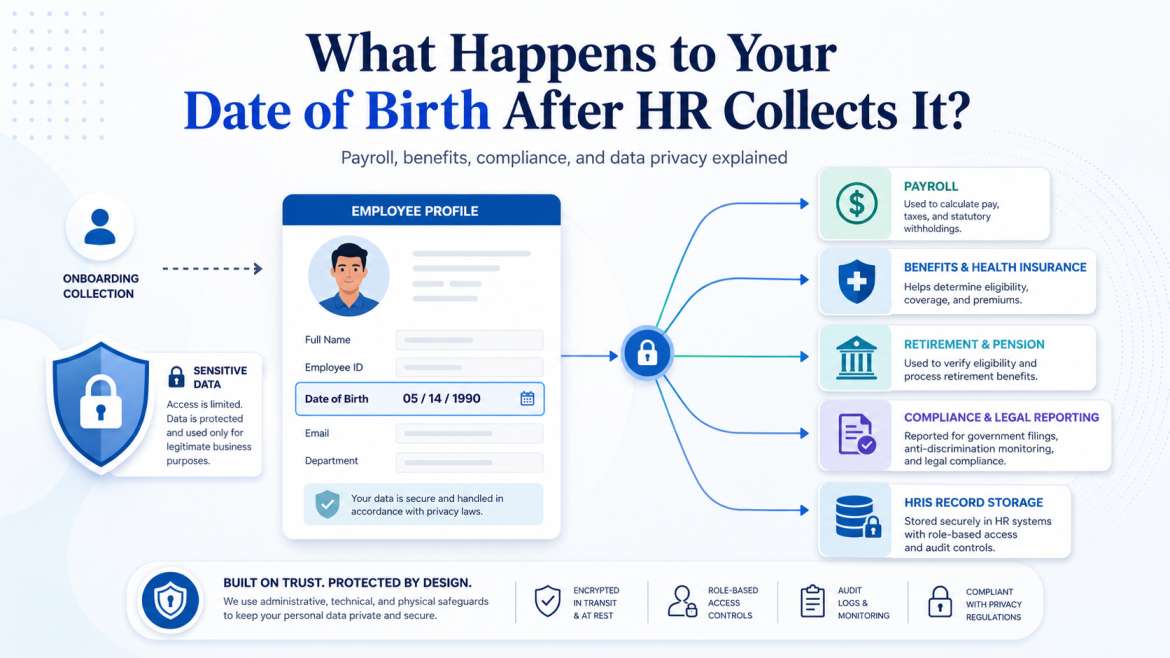
Once your date of birth is on file with an employer, it doesn’t just sit there. It flows into a surprising number of ongoing processes across payroll, benefits administration, compliance reporting, and record-keeping systems, most of which happen quietly in the background without you ever seeing them directly. Understanding what actually happens to this data can help explain why HR departments treat it as sensitive, why they need it accurately, and what your rights are around how it’s stored and protected.
This guide breaks down the specific systems and processes that use your date of birth after it’s collected, so the request that might have seemed like a formality at onboarding makes a lot more sense in context.
Key Takeaways
- Date of birth data primarily supports payroll, benefits, retirement plans, and legal compliance, not day-to-day management decisions.
- Some uses are age-triggered, meaning specific processes only activate once you cross a threshold, like retirement plan catch-up contributions at age 50 in the US.
- HR systems typically store this data under stricter access controls than general employee records, since it’s considered sensitive personal information in most data privacy frameworks.
- Accurate date of birth data matters for avoiding compliance errors, such as incorrect tax withholding or missed benefit eligibility dates.
- You can calculate your exact age yourself at any time to independently verify the same figures HR systems use.
The Systems That Actually Use This Data
Date of birth doesn’t sit in one place. It typically flows into several connected systems, each with a different purpose.
| System | What It Does With Date of Birth | Example Trigger |
|---|---|---|
| Payroll system | Calculates age-based tax withholding differences and verifies eligibility for age-related payroll adjustments | Certain jurisdictions have different withholding rules for workers under 18 |
| Retirement/pension platform | Applies contribution limits, catch-up eligibility, and required distribution timing | US 401(k) catch-up contributions become available starting at age 50 |
| Health insurance administration | Sets premium tiers, dependent coverage rules, and Medicare coordination timing | US employees become Medicare-eligible at 65, which affects employer health plan coordination |
| Life and disability insurance | Feeds underwriting calculations for employer-provided policies | Premiums or coverage caps are frequently age-banded |
| Compliance and legal reporting | Confirms minor labor law adherence and supports government reporting requirements | Verifying a 16- or 17-year-old employee’s work hour limits |
| HRIS (Human Resource Information System) | Stores the record centrally, often with restricted access permissions | Standard record-keeping for the length of employment plus any legally required retention period |
Step-by-Step: The Lifecycle of a Date of Birth Record
| Stage | What Happens |
|---|---|
| 1. Collection | Typically gathered during onboarding paperwork, often through a secure HRIS portal rather than paper forms |
| 2. Verification | Cross-checked against government-issued identification for accuracy, especially for benefits enrollment and background checks |
| 3. Storage | Held in the HRIS under access controls limiting visibility to HR, payroll, and benefits administrators specifically, not general managers |
| 4. Active use | Feeds into the systems listed above on an ongoing basis throughout employment |
| 5. Retention | Kept for the duration of employment plus any legally mandated retention period after separation, which varies by jurisdiction and record type |
| 6. Disposal | Securely deleted or archived according to the company’s data retention policy once retention requirements expire |
Worked Example 1: Retirement Plan Catch-Up Contributions
David turns 50 partway through the year. His employer’s retirement plan administrator uses his exact date of birth, already on file since his hire date, to automatically flag his account as eligible for catch-up contributions starting the month he turns 50, not just the calendar year. This lets him contribute above the standard annual limit for the remainder of the year. None of this required David to submit any new paperwork, since the system was already tracking his exact birth date for this specific purpose.
Worked Example 2: Medicare Coordination
Susan turns 65 while still working full-time and enrolled in her employer’s health plan. Her employer’s benefits system uses her date of birth to flag the exact month she becomes Medicare-eligible, which triggers a required notice about how her employer coverage will coordinate with Medicare going forward. This is a legally required process in the US, and it depends entirely on having an accurate date of birth on file well before the transition happens.
Worked Example 3: A Data Accuracy Error
Tom’s date of birth was entered incorrectly in the HRIS during onboarding, transposing the month and day (a common error format mismatch, since some systems expect MM/DD/YYYY and others expect DD/MM/YYYY). This caused his retirement plan catch-up eligibility to trigger a month later than it should have, and briefly caused a mismatch during a background re-verification process. The error was only caught when Tom noticed the discrepancy on a benefits statement and requested a correction through HR. This illustrates why accuracy in this single data point matters well beyond the moment it’s first entered.
Comparison: How Date of Birth Data Differs From General Employee Data
| Factor | Date of Birth Data | General Employee Data (job title, department, etc.) |
|---|---|---|
| Sensitivity classification | Typically treated as sensitive personal data under privacy frameworks | Usually treated as standard business data |
| Access restrictions | Limited to HR, payroll, and benefits roles specifically | Often visible to managers and broader HR staff |
| Legal retention requirements | Frequently subject to specific retention rules tied to benefits and tax law | Retention driven more by general business record-keeping policy |
| Update frequency | Rarely changes once verified, so errors can persist undetected for years | May be updated frequently as roles and reporting lines change |
| Consequence of inaccuracy | Can affect legally mandated benefits timing and tax withholding | Usually only affects internal reporting or directory accuracy |
How Data Privacy Regulations Treat This Information
Because date of birth is considered personal data, and in some cases sensitive personal data, different privacy frameworks place different obligations on how employers handle it.
| Framework | Region | How It Treats Date of Birth |
|---|---|---|
| GDPR | European Union | Classified as personal data requiring a lawful basis for processing, minimization of collection, and defined retention limits |
| CCPA/CPRA | California, US | Grants employees rights to know, correct, and in some cases delete personal information held by employers, including birth date |
| PIPEDA | Canada | Requires organizations to collect only what’s reasonably needed for a stated purpose and to safeguard it appropriately |
| Various US state laws | United States | A patchwork of state-level privacy laws increasingly grant similar access and correction rights beyond California |
| Sector-specific rules | Varies | Regulated industries like finance and healthcare often layer additional data handling requirements on top of general privacy law |
These frameworks generally share a common thread: date of birth should be collected for a specific, legitimate purpose, protected proportionately to its sensitivity, and made available to the employee for review or correction on request. If your employer operates across multiple countries, the strictest applicable framework often ends up shaping company-wide policy, even for employees in less strict jurisdictions.
Common Mistakes and How to Avoid Them
| Mistake | Why It’s a Problem | The Fix |
|---|---|---|
| Entering date of birth in the wrong date format | Transposed month and day fields can silently create years of incorrect age-based calculations | Double-check the format expected by the specific HR system, especially when it differs from your usual convention |
| Assuming HR record accuracy is guaranteed | Records are only as accurate as their initial entry and are rarely re-verified unless something triggers a review | Check your own benefits statements and paperwork periodically for date of birth accuracy |
| Sharing date of birth over insecure channels when correcting an error | Sensitive personal data sent by casual email increases exposure risk | Use official HR correction channels, which typically require some form of identity re-verification |
| Not understanding why HR needs updated proof of identity for a correction | This step exists specifically because date of birth affects legally sensitive processes | Expect and provide documentation, like a government ID, when requesting a correction |
| Assuming all HR staff can see this data | Access is usually restricted for privacy reasons, not withheld arbitrarily | Understand that a manager not seeing your birth date is standard practice, not an oversight |
A Note on Methodology
This guide reflects standard HR information system practices and generally accepted data privacy principles found in frameworks like the EU’s GDPR and comparable US state privacy laws, alongside common retirement and benefits administration practices in jurisdictions like the United States. Specific retention periods, access controls, and legal requirements vary by country, state, and industry, so this should be treated as a general explanation rather than a compliance guide for any specific organization. For the broader context of why this data is collected in the first place, see our related guide on why employers ask for your exact date of birth.
Frequently Asked Questions
Can I ask my employer what my date of birth data is being used for? Yes. Under most modern data privacy frameworks, employees have a right to understand what personal data is held about them and for what specific purpose, and a legitimate HR department should be able to explain this clearly.
How long does an employer keep my date of birth on file after I leave? This varies significantly by jurisdiction and record type, since some retirement and tax-related records must be kept for years after employment ends, while other data may be deleted sooner according to company policy.
Who at my company can see my exact date of birth? Typically only HR, payroll, and benefits administration staff, since this is usually treated as sensitive data with access restricted beyond what a general manager or coworker can view.
What happens if my date of birth is recorded incorrectly? It can cause errors in age-triggered processes like retirement plan eligibility or Medicare coordination timing, so it’s worth requesting a correction through HR as soon as you notice a discrepancy, usually alongside proof of identification.
Does my employer share my date of birth with anyone outside the company? Sometimes, specifically with third parties who administer benefits, retirement plans, or background checks on the employer’s behalf, though this is typically governed by data processing agreements limiting how that data can be used.
Is my date of birth data protected under data privacy law? In many jurisdictions, yes. Frameworks like the GDPR in the EU classify date of birth as personal data requiring specific protections, and many US state privacy laws include similar provisions.
Why does my retirement plan need my exact date, not just my age? Certain plan features, like catch-up contribution eligibility, activate on the specific date you turn a threshold age, not just at the start of the calendar year you turn that age, so exact precision matters.
Can I request a copy of what date of birth data my employer holds? In many jurisdictions, yes, under data access rights included in privacy legislation. Your HR department or a designated data privacy contact should be able to guide you through this request process.
What proof does HR usually require to correct a date of birth error? Most HR departments will ask for a government-issued form of identification, like a passport or driver’s license, since date of birth feeds into legally sensitive processes and can’t be changed on request alone without some verification step.
Does a former employer keep using my date of birth data after I leave the company? Active use typically stops once you separate from the company, but the record itself is usually retained for whatever period applies to tax, retirement, or legal record-keeping requirements in that jurisdiction, after which it should be securely deleted or archived according to policy.