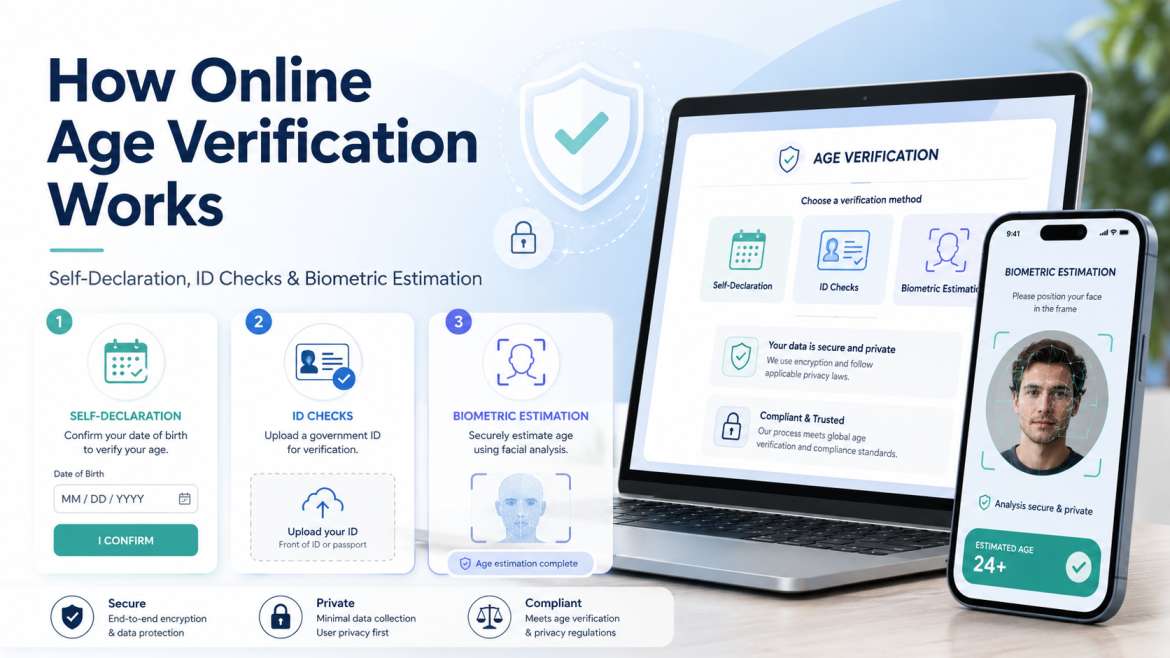
Almost every time you sign up for a new online service, whether it’s a social media platform, a streaming service, an alcohol delivery app, or a financial account, you run into some form of age verification. Sometimes it’s as simple as a single date-of-birth field. Other times it involves uploading a photo ID or completing a facial age estimation scan. The method varies enormously depending on what’s actually at stake legally and how serious the consequences of getting it wrong would be.
This guide walks through the main categories of online age verification, how each one actually works technically, and why the method a platform chooses tends to match the legal risk involved in getting it wrong.
Key Takeaways
- Online age verification methods range from simple self-declaration (just entering a birth date) to document-based verification (uploading a government ID) to biometric age estimation (analyzing a photo or video).
- The method a platform uses generally scales with legal risk: low-stakes content uses self-declaration, while regulated products like alcohol or gambling typically require document verification.
- Self-declared date of birth is easy to falsify and is treated by regulators as a minimal, not sufficient, safeguard for higher-risk products.
- Document and biometric verification typically rely on third-party identity verification services, not the platform itself storing your ID directly in most cases.
- You can always calculate your exact age yourself before entering it anywhere, to make sure the figure you provide is accurate.
The Three Main Categories of Online Age Verification
| Method | How It Works | Typical Use Case |
|---|---|---|
| Self-declaration | User simply enters their date of birth or checks a box confirming they meet the age requirement | Social media sign-up, general content access, low-risk services |
| Document-based verification | User uploads a photo of a government-issued ID, which is checked for authenticity and cross-referenced against entered information | Alcohol delivery, gambling platforms, financial services, age-restricted purchases |
| Biometric age estimation | A photo or short video is analyzed by software trained to estimate age range from facial features | Some social platforms and age-restricted content services as an alternative to document upload |
Step-by-Step: How Document-Based Verification Typically Works
| Step | What Happens |
|---|---|
| 1. Upload | User photographs or scans a government-issued ID, such as a driver’s license or passport |
| 2. Document authenticity check | Automated systems check for security features, format consistency, and signs of tampering or forgery |
| 3. Data extraction | Optical character recognition (OCR) extracts the date of birth and other relevant fields from the document image |
| 4. Cross-reference | Extracted data is compared against information the user entered manually, flagging any mismatch |
| 5. Liveness or selfie match (in some systems) | A live selfie is compared against the ID photo to confirm the document belongs to the person submitting it |
| 6. Decision | The verification service returns a pass, fail, or manual review flag to the platform, without necessarily sharing the full ID image with the platform itself |
Worked Example 1: Signing Up for a Social Media Account
When creating a new social media account, most platforms simply ask for a date of birth during sign-up. The system checks this against the platform’s minimum age requirement (commonly 13, based on regulations like the US Children’s Online Privacy Protection Act). If the entered date doesn’t meet the threshold, the account creation is blocked. No document or photo is involved. This is self-declaration, and it relies entirely on the honesty of the person entering the information, since there’s no independent verification step.
Worked Example 2: Ordering Alcohol for Delivery
When ordering alcohol through a delivery app, the process typically goes further. After placing the order, many services require either an ID check at the door from the delivery driver, or an online document upload during account setup that’s verified against a third-party identity verification service before the order is even processed. This higher bar reflects the more serious legal consequences of selling alcohol to a minor, which can include fines, license suspension, or criminal liability for the seller.
Worked Example 3: Biometric Age Estimation
Some platforms now offer facial age estimation as an alternative to uploading an ID, particularly for users who don’t have one handy or prefer not to share document images. The system analyzes a short video or photo using a model trained on large datasets of faces with known ages, and returns an estimated age range rather than an exact birth date. If the estimated range falls clearly above or below the relevant threshold, the system can make a determination without ever seeing an actual identity document. Borderline cases are typically routed to document verification instead, since age estimation models have a margin of error that grows more significant near an age threshold.
Comparison: Verification Methods by Strength and Friction
| Factor | Self-Declaration | Document-Based | Biometric Estimation |
|---|---|---|---|
| Reliability | Low, easily falsified | High, difficult to falsify convincingly | Moderate, works well except near threshold ages |
| User friction | Minimal, just a form field | Higher, requires locating and photographing a document | Moderate, requires camera access and a live photo or video |
| Privacy considerations | Minimal data collected | Sensitive document data involved, though often processed by a third party rather than stored by the platform directly | No document required, but biometric data has its own sensitivity considerations |
| Typical legal requirement level | Low-risk content and services | High-risk regulated products (alcohol, gambling, financial services) | Emerging alternative for both moderate and high-risk contexts |
| Speed | Instant | Can take seconds to minutes depending on the verification service | Usually near-instant |
The Regulatory Landscape Driving These Requirements
Age verification requirements online aren’t arbitrary design choices, they’re largely shaped by specific legislation in different regions.
| Regulation/Law | Region | What It Generally Requires |
|---|---|---|
| Children’s Online Privacy Protection Act (COPPA) | United States | Restricts data collection from children under 13 without parental consent, which is why many platforms set a minimum sign-up age of 13 |
| Online Safety Act | United Kingdom | Requires platforms hosting certain content types to implement “robust” age verification, pushing many services toward document or biometric methods rather than self-declaration alone |
| Digital Services Act | European Union | Includes provisions around protecting minors online, influencing platform design and verification expectations across member states |
| State-level age verification laws | Various US states | A growing number of states have passed laws specifically requiring stronger age verification for certain categories of online content |
| Gambling and alcohol licensing law | Varies by country | Typically the strictest category, often legally mandating document-based verification rather than leaving it to platform discretion |
Because these requirements differ by region, the same platform may use a lighter verification method for users in one country and a stricter one for users in another, depending on which regulation applies to that user’s location.
Common Mistakes and Misunderstandings
| Mistake | Why It’s Wrong | The Fix |
|---|---|---|
| Assuming self-declared date of birth prevents underage access reliably | It’s trivially easy to enter a false date, so regulators generally don’t treat it as sufficient for high-risk products | Understand that self-declaration is a baseline deterrent, not a real safeguard, for anything with serious legal stakes |
| Believing document uploads are always stored permanently by the platform | Many platforms route this through third-party verification services that confirm a pass/fail result without necessarily retaining or sharing the full document image | Check the specific platform’s privacy policy for how long, if at all, document images are retained |
| Assuming biometric age estimation is always accurate | These systems have a known margin of error, particularly for ages close to a legal threshold | Understand that borderline cases are often escalated to document verification rather than decided purely by the estimate |
| Entering an inaccurate date of birth to bypass an age gate | Beyond violating a platform’s terms of service, this can cause downstream issues if the account is later used for age-dependent features like age-restricted purchases | Enter your accurate date of birth and rely on the platform’s actual eligibility rules rather than working around them |
| Assuming all age verification methods are equally regulated | Requirements vary significantly by country, industry, and specific product risk category | Recognize that a platform’s chosen method usually reflects real legal obligations specific to its content or product type |
A Note on Methodology
This guide describes generally accepted categories of online age verification technology as used across common industries including social media, e-commerce, alcohol delivery, and gambling, based on how these systems are typically described in platform documentation and industry reporting. Specific implementations, retention practices, and legal requirements vary by platform, country, and industry, so this should be treated as a general explanation of how these systems work rather than a guarantee of any specific platform’s practices. For a related look at how this concept plays out in the workplace, see our guide on why employers ask for your exact date of birth, which covers a similar verification need in a different context.
Frequently Asked Questions
Is self-declared date of birth ever considered sufficient for legal compliance? For low-risk content, often yes, since many regulations treat a good-faith declaration combined with a clear age gate as an acceptable baseline. For higher-risk products like alcohol or gambling, it’s typically not considered sufficient on its own.
Does uploading my ID for age verification mean the platform keeps a copy of it? Not always. Many platforms use third-party identity verification services that confirm a pass or fail result to the platform without the platform itself retaining the full document image, though this varies and is worth checking in a platform’s specific privacy policy.
How accurate is facial age estimation technology? It varies by provider, but most systems have a margin of error of a few years, which is generally fine for clearly distinguishing, say, a 35-year-old from a 15-year-old, but less reliable for borderline cases very close to a legal age threshold.
Can I be denied access if my age estimation comes back wrong? Yes, this can happen, particularly near a threshold age, which is why most systems offer a fallback option like document verification if an estimate is disputed or inconclusive.
Why do some websites just ask my age while others require a full ID? The verification method generally scales with legal risk. Low-stakes content uses simple self-declaration, while regulated products carrying real legal liability for incorrect age verification require stronger, harder-to-falsify methods.
Is it illegal to lie about my date of birth to access a website? This depends on the platform’s terms of service and the specific content or product involved. For some regulated products, providing false age information can carry legal consequences beyond just violating a platform’s rules.
What happens if the age verification service can’t confirm my document is genuine? Most systems flag this for manual review rather than an automatic failure, since document scans can be affected by lighting, glare, or camera quality issues unrelated to the document’s actual authenticity.
Do all countries regulate online age verification the same way? No. Requirements vary significantly, with some countries introducing stricter age verification mandates for certain online content categories in recent years, so the specific method a platform uses may differ by the user’s country of residence.