Key Takeaways
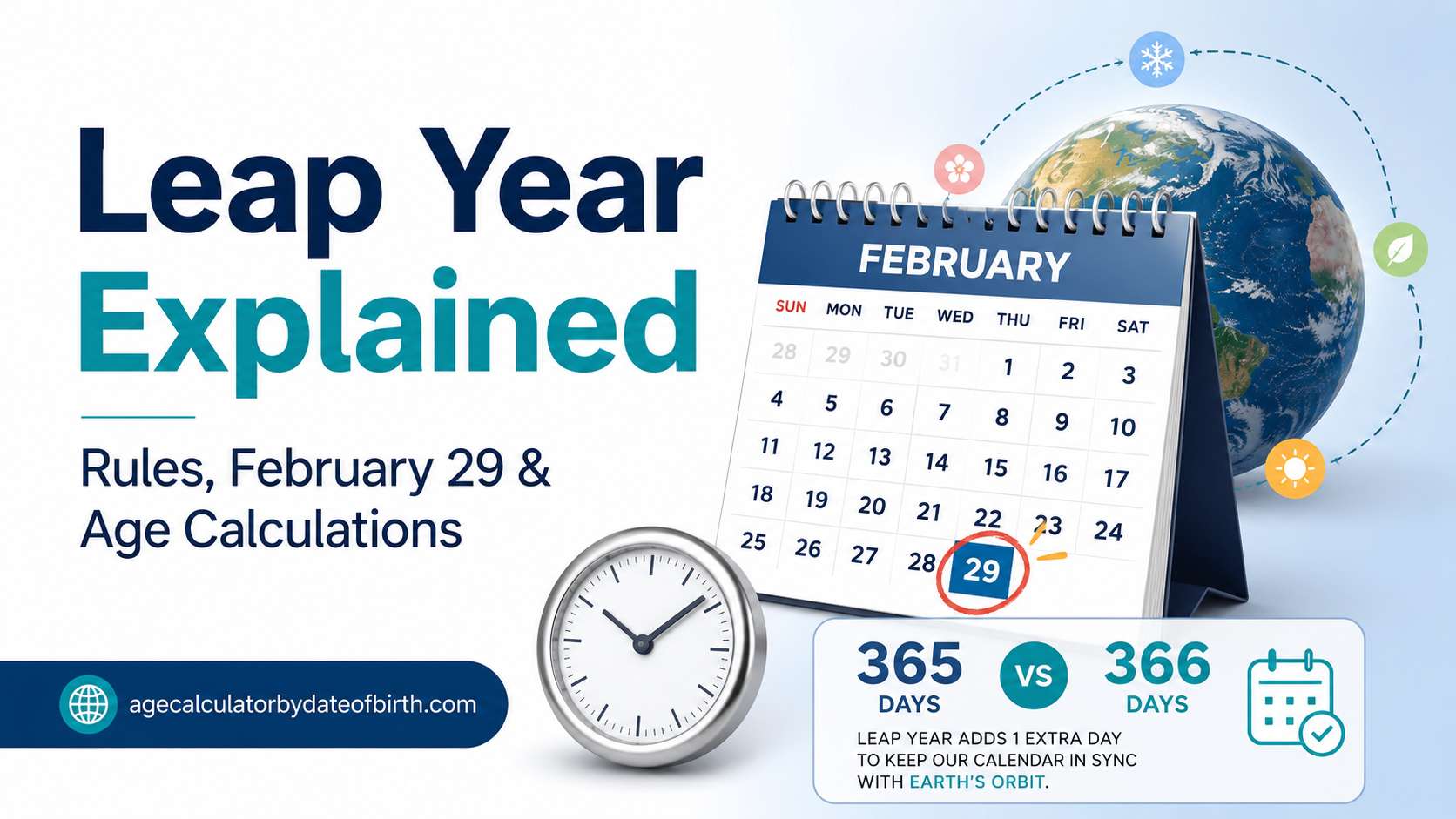
- A leap year is a calendar year with 366 days instead of 365, with the extra day added as February 29.
- Leap years exist because Earth actually takes about 365.2422 days to orbit the sun, not exactly 365, and the extra quarter-day has to go somewhere or the calendar slowly drifts out of sync with the seasons.
- The rule: a year is a leap year if it’s divisible by 4, except century years, which must be divisible by 400 to qualify (so 2000 was a leap year, but 1900 was not).
- Leap years directly affect age calculations for anyone born on or around February 29, and they matter for any precise date-to-date calculation, not just birthdays.
- You can check the exact effect of leap years on any specific age calculation using our free age calculator.
Why the Calendar Needs Leap Years at All
The Gregorian calendar, the one most of the world uses, is built around the idea of a 365-day year. But that number is a rounding of reality, not an exact match to it. Earth’s actual orbit around the sun takes approximately 365.2422 days, roughly 365 days, 5 hours, 48 minutes, and 45 seconds.
If calendars simply ignored that extra fraction of a day every year, the mismatch would seem trivial at first, just under 6 hours annually. But left uncorrected, it compounds. Over just 100 years, that unaccounted time adds up to about 24 days. Over centuries, seasons would gradually shift relative to the calendar date, eventually placing winter months in what the calendar calls summer. Leap years exist specifically to prevent that drift by adding back roughly a full day every four years, keeping the calendar aligned with the actual solar year.
The Leap Year Rule, Explained Step by Step
The commonly known shortcut, “every 4 years is a leap year,” is close but not quite complete. The full rule has three parts.
| Rule | Condition | Example |
|---|---|---|
| 1 | The year is divisible by 4 | 2024 ÷ 4 = 506, so 2024 qualifies |
| 2 | Exception: if the year is also divisible by 100, it is NOT a leap year… | 1900 ÷ 100 = 19, so this exception applies |
| 3 | …unless the year is also divisible by 400, in which case it IS a leap year | 2000 ÷ 400 = 5, so 2000 is a leap year despite being divisible by 100 |
This three-part rule exists because “every 4 years” alone slightly overcorrects. Adding a full extra day every 4 years adds slightly more time than the actual 0.2422-day excess requires. The century exception (rule 2) trims that overcorrection, and the 400-year exception (rule 3) fine-tunes it again, because even the century exception alone would undercorrect slightly. Together, these three rules keep the calendar accurate to within about 1 day every 3,236 years, which is remarkably precise for a system designed centuries ago.
Worked Example: A Straightforward Leap Year
Is 2024 a leap year?
- Is it divisible by 4? 2024 ÷ 4 = 506. Yes.
- Is it divisible by 100? 2024 ÷ 100 = 20.24. No.
- Since it’s divisible by 4 and not divisible by 100, the century exception doesn’t apply.
- 2024 is a leap year. February 2024 has 29 days.
Worked Example: The Century Exception Edge Case
Is 1900 a leap year?
- Is it divisible by 4? 1900 ÷ 4 = 475. Yes.
- Is it divisible by 100? 1900 ÷ 100 = 19. Yes, so we check the 400 rule.
- Is it divisible by 400? 1900 ÷ 400 = 4.75. No.
- Since it’s divisible by 100 but not by 400, 1900 is NOT a leap year, even though it’s divisible by 4.
Compare that to 2000: divisible by 4, divisible by 100, and also divisible by 400 (2000 ÷ 400 = 5 exactly), so 2000 was a leap year. This is the exact edge case that trips up the simplified “every 4 years” version of the rule, and it’s genuinely useful to know if you’re calculating ages or historical dates across a century boundary.
How Leap Years Affect Age and Date Calculations
The extra day in a leap year isn’t just a curiosity, it changes the actual result of date arithmetic in ways that matter for anyone calculating age, deadlines, or the number of days between two dates.
| Scenario | Effect of a Leap Year |
|---|---|
| Calculating someone’s age in days | Adds one extra day to the total for each leap year that falls within the date range |
| Calculating days between two dates spanning February | The range includes 29 days of February instead of 28, changing the total day count |
| A person born on February 29 | Only has a true anniversary of their birth date once every four years, requiring a rule for counting age in non-leap years |
| Recurring deadlines or subscriptions billed “monthly” | Can shift slightly in a leap year if the billing logic counts days rather than calendar months |
This is exactly why manually counting age or days-between-dates across a leap year is a common source of small, hard-to-spot errors. Someone counting “30 days for February” in a leap year would be off by one, and someone assuming “28 days always” would be off by one in the other direction during a leap year.
For the specific question of what happens if you were born on the leap day itself, see our dedicated guide on what happens if you’re born on February 29. For a broader walkthrough of how this affects everyday age calculations, see how leap years affect your age calculation.
Leap Years vs. Regular Years: A Direct Comparison
| Factor | Regular Year | Leap Year |
|---|---|---|
| Total days | 365 | 366 |
| Days in February | 28 | 29 |
| Frequency | 3 out of every 4 years | 1 out of every 4 years (with century exceptions) |
| Effect on someone’s exact age in days | Standard count | One extra day added for each leap year in the range |
| Effect on February 29 birthdays | No true anniversary date exists | The actual birthday occurs |
A Brief History of the Leap Year System
Before the Gregorian calendar (adopted in 1582 and still in use today), the Julian calendar used a simpler rule: every year divisible by 4 was a leap year, with no century exception. That simpler rule overcorrected slightly, adding about 3 extra days every 400 years compared to the actual solar year. Over centuries, this caused a noticeable drift between the calendar and the actual seasons, which is part of why the Gregorian reform introduced the more precise century-based exception still used today. This history matters less for day-to-day age calculation, but it explains why the modern rule has the extra layer of complexity that it does.
Manual Leap Year Checking vs. Using a Calculator
| Factor | Manual Checking | Age or Date Calculator |
|---|---|---|
| Simple years (not divisible by 100) | Easy to check by hand: is it divisible by 4? | Instant either way |
| Century years (1900, 2000, 2100) | Requires remembering the extra 400-year exception, easy to forget | Applied automatically and correctly every time |
| Calculating exact age across multiple leap years | Requires tracking every leap year in the range individually | Calculated in one step |
| Risk of a one-day error in a long date range | Increases with the number of leap years spanned | Effectively eliminated |
Common Mistakes
| Mistake | Why It’s Wrong | The Fix |
|---|---|---|
| Assuming every year divisible by 4 is a leap year | Ignores the century exception, incorrectly marking years like 1900 as leap years | Apply all three parts of the rule: divisible by 4, not by 100 unless also by 400 |
| Assuming February always has 28 days | Produces a one-day error in any date calculation spanning a leap year’s February | Check whether the specific year is a leap year before counting February’s days |
| Forgetting that century years need the extra check | Leads to incorrect assumptions about years like 2100 (not a leap year) or 2000 (a leap year) | Explicitly verify divisibility by 400 for any year divisible by 100 |
| Treating “every 4 years” as perfectly precise | The calendar would still drift over centuries without the century exception | Remember the rule exists precisely because “every 4 years” alone isn’t precise enough |
| Ignoring leap years when counting age in days over many years | Compounds into a multi-day error over a lifetime | Use a calculator that accounts for every leap year individually within the date range |
Frequently Asked Questions
Is 2024 a leap year? Yes. 2024 is divisible by 4 and not a century year, so it follows the simple rule and has 366 days, with February having 29 days.
Is 2100 a leap year? No. 2100 is divisible by 4 and by 100, but not by 400, so it will not be a leap year despite following the “every 4 years” shortcut.
How often does a leap year occur? Generally every 4 years, except that century years not divisible by 400 are skipped, making leap years occur 97 times every 400 years rather than exactly 100 times.
Why is February the month that gets the extra day? This is largely a historical convention from the Roman calendar, where February was already the last and shortest month of the year, making it a natural place to insert the adjustment.
What happens to someone born on February 29 in a non-leap year? They typically observe their birthday on either February 28 or March 1, depending on personal or legal convention, since no February 29 exists that year.
Do leap years affect anything besides the calendar? Yes. They affect precise age calculations, day-count based deadlines, subscription billing cycles, and historical date comparisons that span a leap year.
Was 2000 a leap year? Yes. Despite being a century year, 2000 is divisible by 400, so it followed the leap year rule rather than the century exception.
How can I check whether my age calculation accounts for leap years correctly? Use our free age calculator, which automatically applies the full leap year rule to any date range you enter.
A Note on Method
This guide follows the standard Gregorian calendar leap year rule (divisible by 4, with century exceptions based on divisibility by 400), which is the system in official use worldwide today. For how this rule plays out specifically in age calculations, see how leap years affect your age calculation. For the related question of how many days each month actually has, see how many days are in each month and why.
One thought on “What Is a Leap Year and Why Do We Have Them?”