Key Takeaways
- Months in the Gregorian calendar range from 28 to 31 days, and the pattern isn’t arbitrary, it traces back to Roman calendar reforms over 2,000 years old.
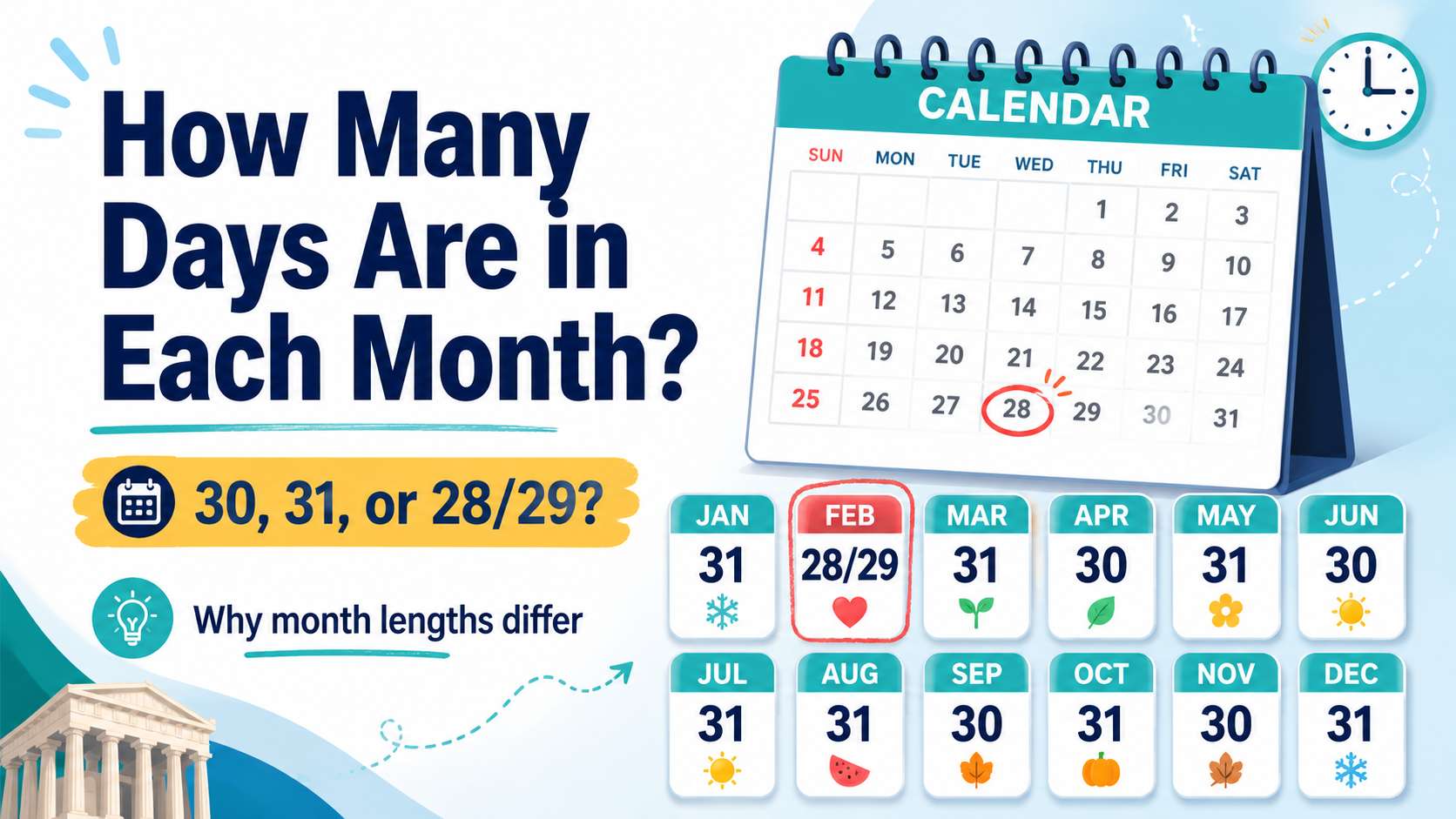
- Seven months have 31 days, four months have 30 days, and February has either 28 or 29 days depending on whether it’s a leap year.
- The uneven month lengths are a major, often overlooked source of manual date-calculation errors, especially when people assume “30 days per month” as a shortcut.
- Knowing the exact day count per month matters for calculating ages, deadlines, subscription periods, and the number of days between any two dates.
- You can skip the manual counting entirely with our free age calculator, which handles varying month lengths automatically.
Why Months Aren’t All the Same Length
It would be far simpler if every month had exactly 30 days, giving a clean 360-day year, or if the year divided evenly into 12 equal chunks. But calendars aren’t designed from scratch with mathematical convenience in mind. They’re inherited systems, shaped by centuries of political decisions, religious observances, and attempts to reconcile the moon-based months of ancient calendars with the sun-based year that seasons actually follow.
The result is the modern Gregorian calendar, where month lengths follow a specific, memorable but non-obvious pattern, and where one month (February) is short specifically to balance out the math elsewhere in the calendar.
The Full Breakdown: Days in Each Month
| Month | Days | Category |
|---|---|---|
| January | 31 | Long month |
| February | 28 (29 in a leap year) | Short month |
| March | 31 | Long month |
| April | 30 | Short month |
| May | 31 | Long month |
| June | 30 | Short month |
| July | 31 | Long month |
| August | 31 | Long month |
| September | 30 | Short month |
| October | 31 | Long month |
| November | 30 | Short month |
| December | 31 | Long month |
Seven months (January, March, May, July, August, October, December) have 31 days. Four months (April, June, September, November) have 30 days. February alone has 28 or 29, depending on the year.
The Memory Trick
Many people learn this pattern through the traditional rhyme: “Thirty days hath September, April, June, and November; all the rest have thirty-one, except February alone.” Another common method is the “knuckle trick,” counting knuckles and the dips between them across both hands, where each knuckle represents a 31-day month and each dip represents a shorter month. Both are useful shortcuts, but neither explains why the pattern exists in the first place.
The Historical Reason Behind the Pattern
The pattern traces back to the Roman calendar, which originally had 10 months and later expanded to 12. Over time, as Roman leaders adjusted the calendar (notably under Julius Caesar’s reform in 46 BCE, which produced the Julian calendar), month lengths were shuffled to fit the days of the year into 12 months while keeping the calendar roughly aligned with the solar year.
February ended up as the short month largely because it was originally the last month of the Roman calendar year, and it became the natural place to make small adjustments, including the periodic addition of extra days to keep the calendar synced with the seasons. That adjustment role continues today, expressed as the leap year rule, which is covered in detail in our guide on what a leap year is and why we have them.
A popular but disputed legend claims that August was lengthened to 31 days (from an original 30) so that Emperor Augustus’s month would match Julius Caesar’s July in length, supposedly taking a day from February in the process. Most calendar historians consider this specific story more folklore than documented fact, though the broader pattern of political influence shaping month lengths over centuries is well established.
Worked Example: Standard Case, Calculating Days Between Two Dates in the Same Year
How many days are there from March 5 to July 5 of the same, non-leap year?
- March 5 to April 5: March has 31 days, so this span is 31 days.
- April 5 to May 5: April has 30 days, so this span is 30 days.
- May 5 to June 5: May has 31 days, so this span is 31 days.
- June 5 to July 5: June has 30 days, so this span is 30 days.
- Total: 31 + 30 + 31 + 30 = 122 days.
Notice that a naive shortcut of “4 months × 30 days = 120 days” would have been wrong by 2 days, because two of the four months in this range (March and May) actually have 31 days.
Worked Example: Edge Case, Spanning February in a Leap Year
How many days are there from January 20 to March 20, in a leap year (February has 29 days)?
- January 20 to February 20: January has 31 days, so this span is 31 days.
- February 20 to March 20: February has 29 days in a leap year, so this span is 29 days.
- Total: 31 + 29 = 60 days.
In a non-leap year, the same date range would total 59 days instead, since February would only contribute 28 days to the span. This single-day difference is exactly the kind of detail that causes manual calculations to quietly drift off by one, particularly for anyone calculating an exact age or a deadline that spans February.
Why “30 Days Per Month” Is a Risky Shortcut
It’s tempting to treat every month as roughly 30 days for quick mental math, and for a rough estimate, that’s fine. But for anything that needs to be exact, an age calculation, a legal deadline, a billing cycle, an eligibility cut-off, this shortcut introduces real error.
| Scenario | “30 Days Per Month” Estimate | Actual Result | Error |
|---|---|---|---|
| Days from January 1 to April 1 | 90 days (3 × 30) | 90 days (Jan 31 + Feb 28 + Mar 31 = 90) | 0 days (coincidentally correct in a non-leap year) |
| Days from May 1 to August 1 | 90 days | 92 days (May 31 + Jun 30 + Jul 31 = 92) | 2 days |
| Days from February 1 to March 1, leap year | 30 days | 29 days | 1 day |
| Days from February 1 to March 1, non-leap year | 30 days | 28 days | 2 days |
As the table shows, the shortcut sometimes lands exactly right by coincidence and sometimes doesn’t, which is worse than being reliably wrong, since it creates false confidence in an approach that isn’t actually consistent.
Manual Counting vs. Using a Calculator
| Factor | Manual Counting | Date/Age Calculator |
|---|---|---|
| Counting days within a single month | Easy, just look up the month’s day count | Instant |
| Counting days across multiple months of different lengths | Requires adding up each month’s actual day count correctly | Automatic and exact |
| Accounting for leap years in February | Easy to forget which years qualify | Applied automatically using the full leap year rule |
| Risk of error over long date ranges | Increases with the number of months and leap years spanned | Effectively eliminated |
| Good for quick, rough estimates | Reasonably fine | Also fine, and exact |
| Good for legal, medical, or financial deadlines | Risky without careful double-checking | Reliable |
Common Mistakes
| Mistake | Why It’s Wrong | The Fix |
|---|---|---|
| Assuming every month has 30 days | Seven months actually have 31 days, and February has 28 or 29, so this consistently introduces error | Look up or calculate the specific day count for each month involved |
| Forgetting February’s day count depends on the year | Produces a one or two day error whenever a date range spans February | Check whether the relevant year is a leap year before counting February |
| Multiplying “months × 30” for a long date range | Compounds the per-month error across every month in the range | Add up the actual day counts of each specific month rather than using a flat average |
| Confusing the rhyme’s exception (“except February alone”) with a fixed 28-day rule | Ignores that February has 29 days in leap years | Remember February’s count is conditional, not fixed |
| Assuming August’s extra day is a documented historical fact | The Augustus/February story is disputed folklore, not settled history | Treat the calendar’s evolution as a mix of documented Roman reform and less certain legend |
Frequently Asked Questions
How many months have 31 days? Seven: January, March, May, July, August, October, and December.
How many months have 30 days? Four: April, June, September, and November.
Why does February have fewer days than every other month? It traces back to Roman calendar reforms in which February became the month used to balance the calendar’s overall day count, a role it still plays today through the leap year rule.
Is there a reliable trick to remember which months have 31 days? Yes, the traditional “Thirty days hath September” rhyme and the knuckle-counting method are both widely used memory aids.
Does the day count of any month ever change, besides February? No. Only February’s length varies, between 28 and 29 days depending on whether the year is a leap year.
Why isn’t every month just 30 or 31 days evenly split? The 365-day year doesn’t divide evenly into 12 months of any single fixed length, and the specific historical pattern is a product of calendar reforms rather than pure mathematical design.
How does this affect calculating someone’s exact age? Any age calculation that spans multiple months needs to account for each month’s actual day count, or the result can be off by a day or more, especially across February.
What’s the easiest way to calculate days between two dates without doing this by hand? Use our free age calculator, which handles varying month lengths and leap years automatically for any date range.
A Note on Method
This guide follows the standard Gregorian calendar month lengths currently in official use worldwide, with historical notes drawn from the well-documented Julian calendar reform. For the related leap year rule that determines February’s length in any given year, see what is a leap year and why do we have them.