Key Takeaways
- Your Chinese zodiac sign is based on your birth year, not your birth month like Western astrology, and follows a repeating 12-year cycle of animals.
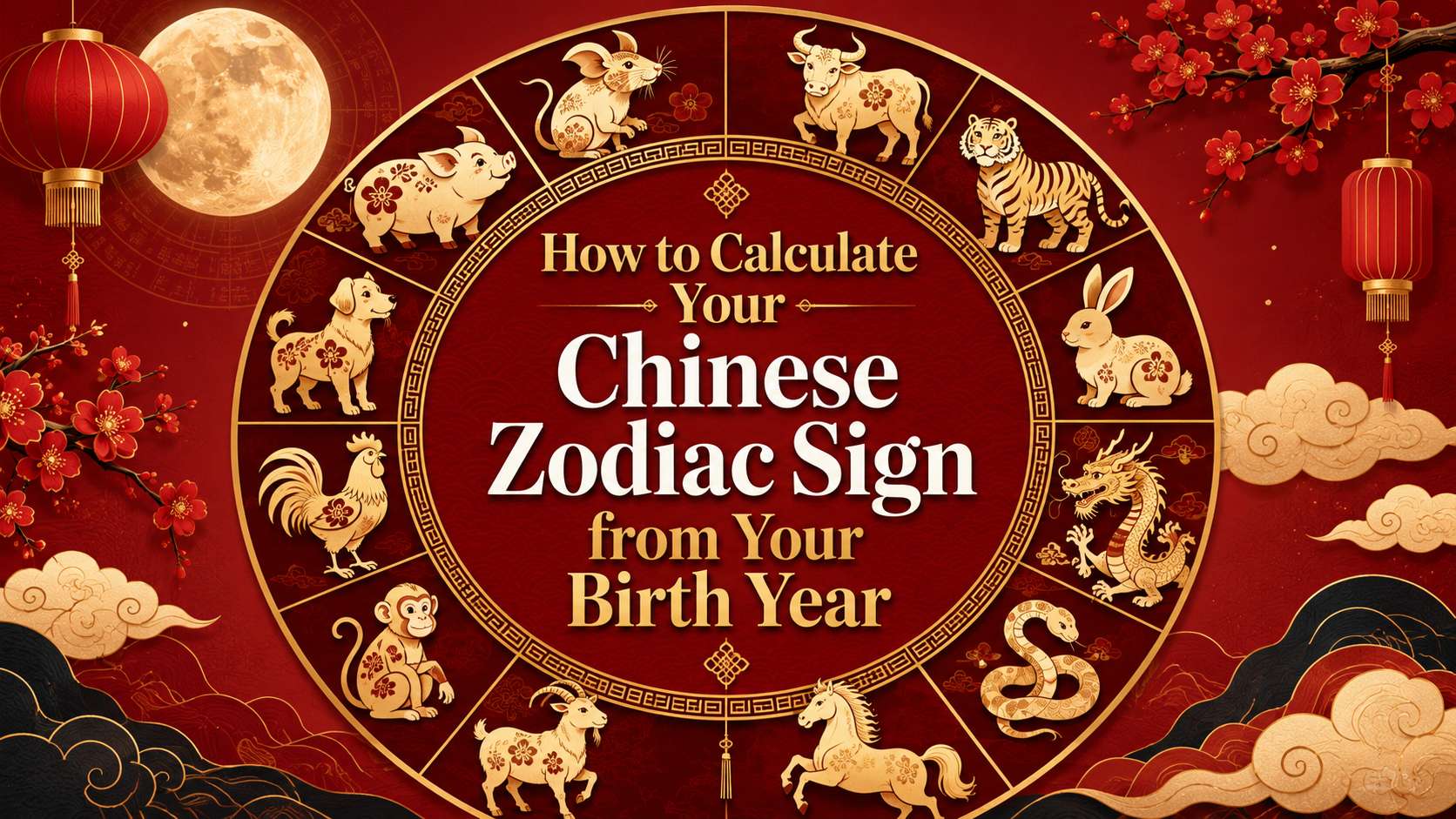
- The twelve animals, in order, are: Rat, Ox, Tiger, Rabbit, Dragon, Snake, Horse, Goat, Monkey, Rooster, Dog, and Pig.
- The single biggest source of error: the Chinese zodiac year does not start on January 1. It starts on Chinese New Year, a date that shifts between January 21 and February 20 each year based on the lunar calendar.
- If you were born in January or early February, your zodiac animal may belong to the previous Gregorian year, not the one on your birth certificate.
- Beyond the animal, Chinese astrology also assigns one of five elements (Wood, Fire, Earth, Metal, Water) on a 60-year cycle, giving each sign additional nuance.
How the Chinese Zodiac Calendar Works
Unlike Western astrology, which divides the year into twelve roughly month-long segments, the Chinese zodiac assigns one full year to each of twelve animals, cycling continuously. The cycle repeats every 12 years, so anyone born in 1988, 2000, or 2012 shares the same zodiac animal.
The complicating factor is that the Chinese zodiac year runs on the traditional Chinese lunisolar calendar, which does not line up with January 1. Instead, each zodiac year begins on Chinese New Year, also called Lunar New Year, which typically falls somewhere between January 21 and February 20 depending on the lunar cycle.
This means a baby born on January 15, 2026 is technically still under the 2025 zodiac animal, because Chinese New Year 2026 doesn’t arrive until February 17. Calculators and articles that simply divide the Gregorian birth year by 12 get this wrong for anyone born in that January-to-mid-February window, roughly 10% of the population in an average year.
The 12 Chinese Zodiac Animals and Recent Years
| Animal | Recent Years (approximate, adjust for exact Chinese New Year date) |
|---|---|
| Rat | 1984, 1996, 2008, 2020, 2032 |
| Ox | 1985, 1997, 2009, 2021, 2033 |
| Tiger | 1986, 1998, 2010, 2022, 2034 |
| Rabbit | 1987, 1999, 2011, 2023, 2035 |
| Dragon | 1988, 2000, 2012, 2024, 2036 |
| Snake | 1989, 2001, 2013, 2025, 2037 |
| Horse | 1990, 2002, 2014, 2026, 2038 |
| Goat | 1991, 2003, 2015, 2027, 2039 |
| Monkey | 1992, 2004, 2016, 2028, 2040 |
| Rooster | 1993, 2005, 2017, 2029, 2041 |
| Dog | 1994, 2006, 2018, 2030, 2042 |
| Pig | 1995, 2007, 2019, 2031, 2043 |
Treat this table as a starting point, not a final answer, if you were born in January or February: always cross-check the exact Chinese New Year date for your specific birth year before finalizing your sign.
How to Calculate Your Sign, Step by Step
| Step | What to Do |
|---|---|
| 1 | Note your exact birth date (day, month, year), not just the year |
| 2 | Look up the Chinese New Year date for your birth year (it shifts annually) |
| 3 | If your birthday falls on or after that year’s Chinese New Year, use the standard table above for your birth year |
| 4 | If your birthday falls before that year’s Chinese New Year (i.e., in January or early February), use the animal for the previous year instead |
| 5 | Optionally, calculate your element by using the last digit of your birth year (0-1: Metal, 2-3: Water, 4-5: Wood, 6-7: Fire, 8-9: Earth) |
Worked Examples
Example 1: Someone born on July 4, 1990. Since this birthday falls well after Chinese New Year that year (which occurred in late January 1990), the standard lookup applies directly: this person is a Horse, no adjustment needed.
Example 2: Someone born on January 15, 2026. Chinese New Year 2026 falls on February 17, so this birthday occurs before the cutoff. Even though 2026 is the Year of the Horse, this person’s zodiac animal is actually the Snake, carried over from 2025. This is the classic edge case that trips up simple year-only calculators.
Example 3: Someone born on February 17, 2026, exactly on Chinese New Year itself. Chinese New Year is generally treated as the first day of the new zodiac year, so a birth on that exact date typically counts under the new year’s animal, in this case the Horse, though some regional traditions calculate the cutover slightly differently. When in doubt on an exact boundary date, cross-reference a lunar calendar source specific to that year.
Chinese Zodiac Elements
Beyond the animal, Chinese astrology layers on one of five elements, forming a fuller 60-year cycle (12 animals x 5 elements). The element is generally derived from the last digit of the birth year:
| Last Digit of Birth Year | Element |
|---|---|
| 0 or 1 | Metal |
| 2 or 3 | Water |
| 4 or 5 | Wood |
| 6 or 7 | Fire |
| 8 or 9 | Earth |
So someone born in 2024 (Dragon, last digit 4) is a Wood Dragon, while someone born in 1988 (also Dragon, last digit 8) is an Earth Dragon, a different combination even though both share the same animal.
Chinese Zodiac vs. Western Zodiac: A Comparison
| Feature | Chinese Zodiac | Western Zodiac |
|---|---|---|
| Based on | Birth year | Birth month/day range |
| Number of signs | 12 animals | 12 signs |
| Cycle length | 12 years (60 with elements) | 1 year |
| Calendar basis | Lunisolar (Chinese New Year cutoff) | Solar (Gregorian calendar) |
| Additional layer | Five elements | Ruling planets |
If you’re curious about the Western system too, a different birth-date-based system works on entirely separate calculation rules from the Chinese zodiac.
Common Mistakes When Calculating Chinese Zodiac Sign
| Mistake | Why It’s Wrong | The Fix |
|---|---|---|
| Using only the Gregorian birth year | Ignores the Lunar New Year cutoff entirely | Always check the exact Chinese New Year date for that specific year |
| Assuming Chinese New Year always falls on the same date | It shifts every year between January 21 and February 20 | Look up the specific year’s date rather than assuming a fixed day |
| Forgetting the January/early-February edge case | About 10% of people fall in this window and get the wrong animal from simple calculators | Cross-check any birthday before mid-February against that year’s cutoff |
| Confusing zodiac animal with zodiac element | These are two separate, overlapping cycles | Calculate both separately using the animal table and the element table |
| Mixing up Chinese zodiac with Western zodiac rules | They use entirely different calculation bases (year vs. month/day) | Treat them as two unrelated systems |
Why Your Exact Age Matters Here
Since Chinese zodiac calculation depends on your exact birth date relative to a shifting Lunar New Year cutoff, not just your birth year, it helps to know your precise date of birth details clearly before calculating your sign. You can also use our free age calculator to double-check your exact birth date details alongside your zodiac lookup.
Frequently Asked Questions
How do I find my Chinese zodiac sign from my birth year?
Match your birth year to the 12-year animal cycle, but first check whether your birthday falls before or after that year’s Chinese New Year date, since this determines which animal actually applies.
What if I was born in January or February?
Check the exact Chinese New Year date for your birth year. If your birthday falls before it, your zodiac animal is the one assigned to the previous year, not your literal birth year.
What are the 12 Chinese zodiac animals in order?
Rat, Ox, Tiger, Rabbit, Dragon, Snake, Horse, Goat, Monkey, Rooster, Dog, and Pig, repeating in that order every 12 years.
Does the Chinese zodiac use months like Western astrology?
No. The Chinese zodiac assigns a full year to each animal, while Western astrology divides the year into twelve month-based sign ranges.
What are the five Chinese zodiac elements?
Wood, Fire, Earth, Metal, and Water, each paired with your animal sign based on the last digit of your birth year, creating a fuller 60-year cycle.
Can two people share the same zodiac animal but be different elements?
Yes. Since the animal cycle is 12 years and the element cycle overlays a 60-year pattern, people born 12 years apart can share an animal but have different elements.
Is the Chinese zodiac the same as Chinese astrology overall?
The zodiac animal is one part of the broader Chinese astrology system, which also considers elements, yin/yang balance, and other traditional factors.
Why does Chinese New Year change dates every year?
Because the Chinese calendar is lunisolar, based on moon cycles adjusted to stay roughly aligned with the solar year, causing the new year date to shift within a roughly one-month window annually.
Methodology Note
This guide follows the standard Chinese lunisolar calendar convention for determining zodiac year boundaries, cross-referenced against published Chinese New Year dates for each cited year. Because exact Chinese New Year dates must be looked up per year, readers with a birthday in January or early February should always verify against a reliable lunar calendar source for their specific birth year rather than relying on year-only shortcuts.