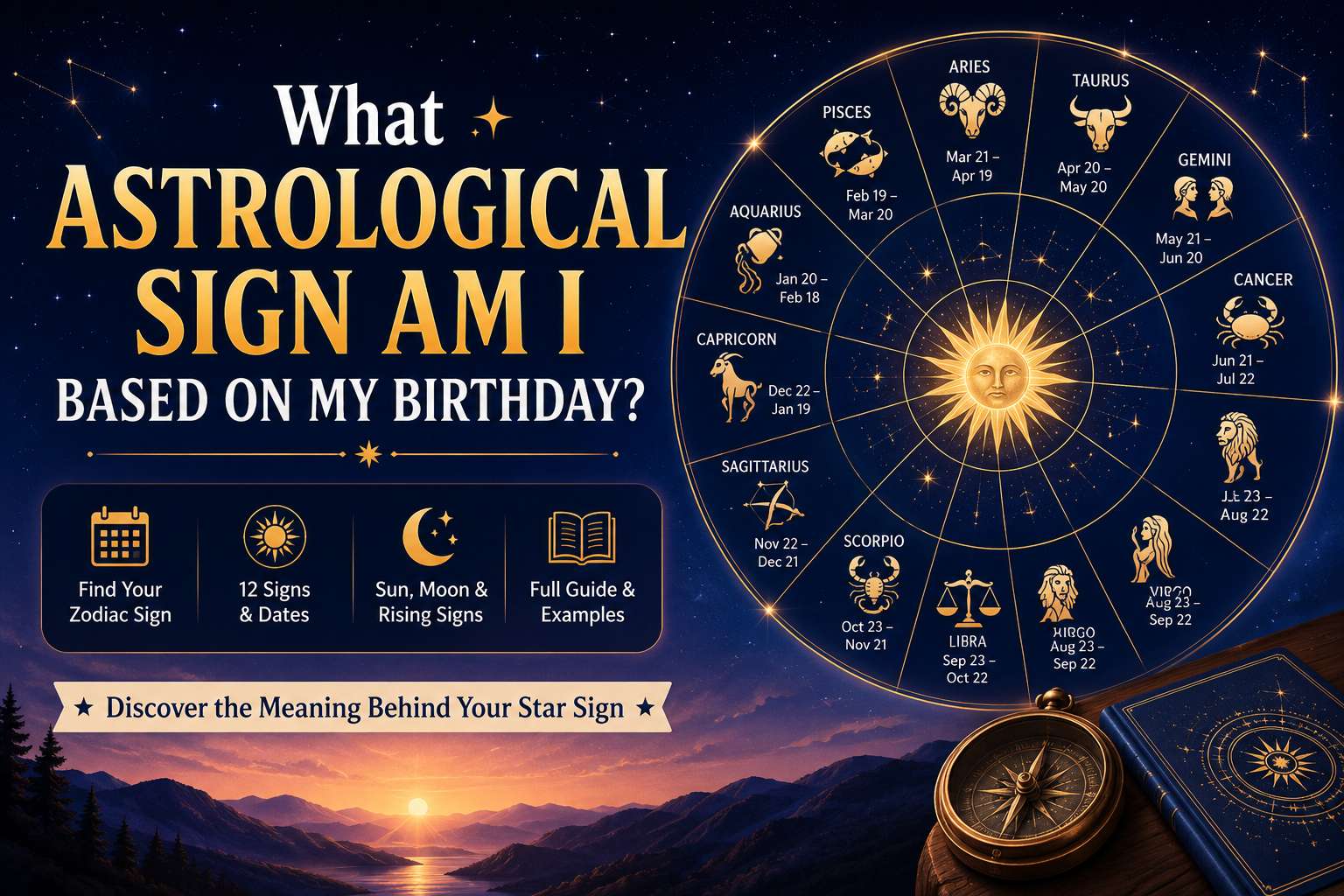
Key Takeaways
- Your Western zodiac sign, also called your sun sign, is determined by the specific date range your birthday falls into, not your birth year.
- There are 12 signs, each covering roughly a one-month window, though the exact start and end dates shift slightly by a day or two depending on the year.
- If your birthday falls right on a boundary date, you may have a cusp birthday, meaning you should double check the exact time and location of your birth for full accuracy.
- Your sun sign is only one part of a full astrological chart. Your moon sign and rising sign depend on your exact birth time and location, not just the date.
- Western zodiac signs are calculated completely differently from the Chinese zodiac, which is based on birth year rather than a specific date range.
The 12 Zodiac Signs and Their Date Ranges
| Sign | Typical Date Range | Element |
|---|---|---|
| Aries | March 21 – April 19 | Fire |
| Taurus | April 20 – May 20 | Earth |
| Gemini | May 21 – June 20 | Air |
| Cancer | June 21 – July 22 | Water |
| Leo | July 23 – August 22 | Fire |
| Virgo | August 23 – September 22 | Earth |
| Libra | September 23 – October 22 | Air |
| Scorpio | October 23 – November 21 | Water |
| Sagittarius | November 22 – December 21 | Fire |
| Capricorn | December 22 – January 19 | Earth |
| Aquarius | January 20 – February 18 | Air |
| Pisces | February 19 – March 20 | Water |
These date ranges are the most commonly used tropical zodiac dates, though they can shift by a day in either direction depending on the specific year, since they’re tied to solar positions (like the equinoxes and solstices) rather than fixed calendar dates.
Why the Dates Sometimes Shift by a Day
Zodiac sign boundaries are based on the sun’s position relative to the 12 zodiac constellations in tropical astrology, which is anchored to solar events like the spring equinox. Because a calendar year (365.25 days) doesn’t divide evenly, the exact moment the sun crosses into the next sign can land on a slightly different calendar day each year, sometimes shifting a boundary date by one day. This is why some charts list Aries as starting March 20 in one year and March 21 in another.
What Is a Cusp Birthday?
If your birthday falls within a day or two of a listed boundary date (for example, April 19-21 for the Aries-Taurus boundary), you’re considered to have a cusp birthday. In these cases, the exact sign depends on the precise year, and sometimes the exact time and location of birth, since the sun’s position shifts throughout the day. If your birthday is within two days of any boundary in the table above, it’s worth checking a specific astrological calculation for your exact birth year rather than relying on the general date range.
Worked Examples
Example 1: A birthday on July 10. This falls solidly within the Cancer range (June 21 – July 22), well clear of any boundary, so the sign is straightforward: Cancer.
Example 2: A birthday on April 20. This sits right on the boundary between Aries and Taurus. Depending on the exact year and the precise hour of the solar transition, this person could be either an Aries or a Taurus, technically a cusp case. Checking the specific year’s equinox and transition times, or simply noting both possibilities, is the accurate approach here.
Example 3: A birthday on December 25. This falls within Capricorn (December 22 – January 19), a date range that spans across the New Year. This is a useful edge case: Capricorn, unlike every other sign, starts in one calendar year and ends in the next, which can confuse anyone assuming each sign stays within a single year.
Sun Sign vs. Moon Sign vs. Rising Sign
| Sign Type | Based On | What It Represents (in astrology) |
|---|---|---|
| Sun sign | Birth date only | Core identity, most commonly referred to as “your zodiac sign” |
| Moon sign | Birth date, time, and location | Emotional and inner self |
| Rising sign (Ascendant) | Exact birth time and location | Outward personality and first impressions |
The date chart above only calculates your sun sign, the most commonly referenced sign in casual conversation. A full birth chart requires your exact birth time and location in addition to the date, since moon and rising signs shift throughout each day.
Western Zodiac vs. Chinese Zodiac: A Comparison
| Feature | Western (Sun Sign) | Chinese Zodiac |
|---|---|---|
| Based on | Specific birth date range | Birth year |
| Number of signs | 12 | 12 |
| Cycle length | 1 year (repeats annually) | 12 years |
| Precision needed | Day and sometimes time of birth | Year, adjusted for Lunar New Year cutoff |
If you’re curious how the two systems compare directly for your own birthday, another zodiac system worth knowing uses your birth year instead of a date range, and often gives an entirely different-feeling result.
Common Mistakes When Finding Your Zodiac Sign
| Mistake | Why It’s Wrong | The Fix |
|---|---|---|
| Assuming zodiac date ranges are fixed every year | Boundaries can shift by a day depending on the specific year’s solar transitions | Check the exact transition date for your specific birth year if you’re near a boundary |
| Ignoring cusp birthdays | Being born within a day or two of a boundary can put you in either adjacent sign | Verify with a precise astrological calculation if your birthday is close to a listed boundary |
| Confusing sun sign with full birth chart | Sun sign is just one part of a complete astrological profile | Get your exact birth time and location for moon and rising sign calculations |
| Mixing up Western and Chinese zodiac rules | These are unrelated systems using entirely different calculation bases | Treat them separately: one uses date range, the other uses birth year |
| Assuming Capricorn stays within one calendar year | Capricorn’s date range spans December into January | Remember Capricorn is the one sign that crosses the New Year boundary |
Why Your Exact Age Matters Here
Knowing your exact birthday, and how many days have passed since it, is useful context whether you’re calculating your zodiac sign or just curious about your age. You can check both easily on our homepage using your date of birth.
Frequently Asked Questions
How do I know what zodiac sign I am?
Match your birthday to the date range in the chart above. If your birthday falls close to a boundary date, you may have a cusp birthday worth checking more precisely.
What are the zodiac sign dates?
Aries (March 21-April 19), Taurus (April 20-May 20), Gemini (May 21-June 20), Cancer (June 21-July 22), Leo (July 23-August 22), Virgo (August 23-September 22), Libra (September 23-October 22), Scorpio (October 23-November 21), Sagittarius (November 22-December 21), Capricorn (December 22-January 19), Aquarius (January 20-February 18), and Pisces (February 19-March 20).
What is a cusp sign?
A cusp sign refers to a birthday that falls within a day or two of a zodiac boundary date, meaning the exact sign can depend on the specific year and even the time of day you were born.
What’s the difference between a sun sign and a moon sign?
Your sun sign is based purely on your birth date, while your moon sign requires your exact birth time and location, since the moon’s position shifts throughout each day.
Why do zodiac date ranges shift slightly each year?
Because sign boundaries are tied to the sun’s position relative to solar events like the equinoxes, and a calendar year doesn’t divide evenly, the exact crossover moment can land on a different calendar day each year.
Is the Western zodiac the same as the Chinese zodiac?
No. Western zodiac signs are based on a specific date range within a single year, while Chinese zodiac signs are based on the entire birth year within a 12-year cycle.
Which zodiac sign spans two calendar years?
Capricorn is the one sign whose date range crosses the New Year boundary, running from December 22 through January 19.
Do I need my exact birth time to know my zodiac sign?
Not for your sun sign, which only requires the date. Birth time becomes necessary for calculating your moon sign, rising sign, and full birth chart.
Methodology Note
Zodiac sign date ranges in this guide follow the standard tropical (Western) astrology convention most commonly used in mainstream references. Because boundary dates can shift by a day depending on the exact year’s solar transitions, readers with a birthday within a day or two of any listed boundary should verify against a precise astrological source for their specific birth year.